This isn't much of a conversion - in fact all I've done is paint over the blue and white segments (aking them paler blue and yellow respectively) on the Czechoslovak army roundel on this Altaya T-55. It's now an Andreivian Armenian vehicle. I'm debating as to whether I should overpaint the white stripes too.
The only slight interest is that this is the first picture taken with my new iPhone. Or to be precise, the first sharp picture. I'm just getting the hang of how to avoid camera shake with the phone.
Friday, February 28, 2014
Saturday, February 22, 2014
Red Counterthrust
Today we played the Red Counterthrust scenario from the excellent Skirmish Campaigns book Grossdeutschland at Kursk.
I tweaked the scenario to fit the models I had available and we ended up pitting five Panzer III Ausf J, a Panzer Grenadier squad and a 7,5cm infantry gun (under Jamie's command) against seven T-34s, two SU-76s, and a Soviet motorised infantry squad.
The terrain was rolling countryside with scattered, open woods.
Jamie deployed the whole of his PzIII tank platoon (five vehicles) in a line in the open ground between the central woods and the stream. I was a bit concerned they were too much in the open (but I needn't have been).
Andy's luck got no better. Another of his T-34s was immobilised by long-distance fire from the German Panzers, and then the tanks crossing the bridge were targeted.
I tweaked the scenario to fit the models I had available and we ended up pitting five Panzer III Ausf J, a Panzer Grenadier squad and a 7,5cm infantry gun (under Jamie's command) against seven T-34s, two SU-76s, and a Soviet motorised infantry squad.
The terrain was rolling countryside with scattered, open woods.
| The Soviet forces were to enter from either of the roads to the north (right in this view) of the stream. The Germans were to deploy on the southern (left) half of the table. |
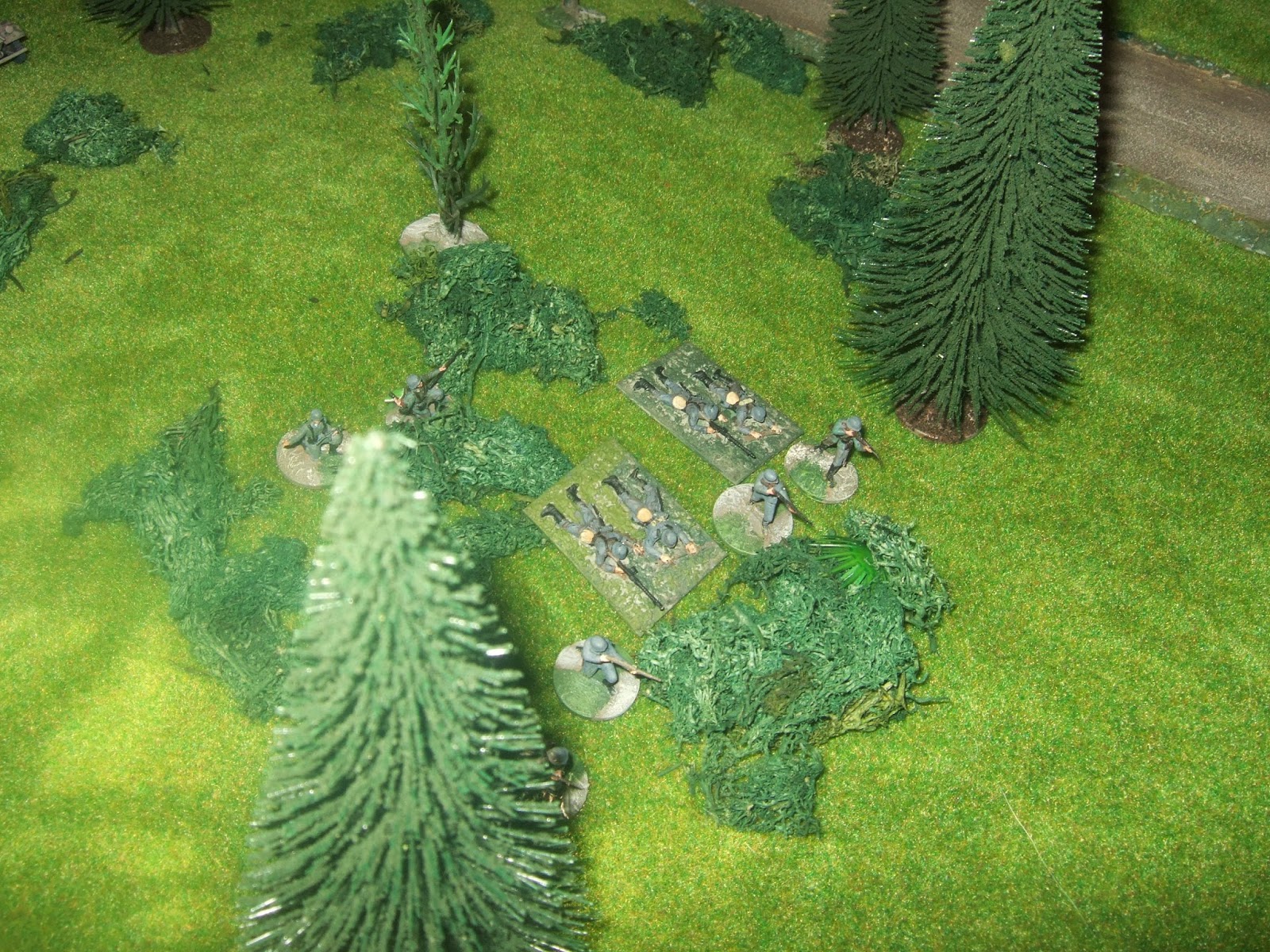
| The German defenders - tanks forward, infantry and infantry gun in reserve. |
| Game turn 1. The Soviet company commander's tank enters and is KO'd by fire from the Panzer IIIs. |
| More Soviet forces converge on the bridge. |
The lead tank was knocked out and the second and third were immobilised with their crews bailing out. This left the bridge blocked and forced the remaining Soviet tank platoon to try and cross the difficult river banks.
Unfortunately for Andy both would spend some time crossing, and getting stuck in, the unstable banks of the stream.
Meanwhile, the Germans' reinforcements, two Tigers, arrived on the earliest possible turn!
| Two Tigers - enough to strike fear in the heart of any allied tanker. |
| Andy's infantry head for the river bank. |
| Both SU-76s are brewed up despite their hull-down position. |
| Although things are going well for the Germans, their Panzer III platoon has two units temporarily neutralised and one permanently immobilised by incoming fire. |
| The infantry gun awaits more targets. |
| The Soviet motorised rifle squad cover behind the knocked out tanks on the approach to the bridge. |
| With one of the two remaining T-34s permanently mired in the stream, Andy is forced to accept that the battle is lost on game turn 4. |
All in all I'm pleased with how the battle went. The rules worked well. Andy can justifiably feel annoyed that everything that could go wrong did so but I'm pleased that Jamie has managed to play a WW2 game without being trashed.
Wednesday, February 19, 2014
Progress on the Andreivian Coaster
I'm making progress in my plan to turn a 1/142nd scale trawler in to a 1/72nd scale trading vessel.
First pic some of the unwanted detail removed, including the winches which left a hole in the deck in front of the superstructure.
Second pic, more detail removed and a new front superstructure made from plastic card.
Third pic, superstructure completed and deck hole plated over. Railing holes filled with green stuff and hull cut down to waterline level.
Next job is to add hatch and windows to the new superstructure and build one large hatch-cover on the foredeck. Oh and to find a suitable ship's boat.
Sunday, February 16, 2014
Goods Shed
This weekend I finished the Goods Shed I bought at Vapnartak.
It was reasonably easy to build, the only tricky parts being that some of the side sections needed to be butted together with little support and that the sides lack a positive attachment to the roof. A little judicious application of superglue fixed that.
It's a 1/72nd scale injection moulded kit from a Ukrainian manufacturer called Mini Art. I've included a Matchbox SdKfz251/1 for scale comparison.
It was reasonably easy to build, the only tricky parts being that some of the side sections needed to be butted together with little support and that the sides lack a positive attachment to the roof. A little judicious application of superglue fixed that.
This building will see action somewhere in downtown Tcherbevan but will also be idea if I get round to playing the Berezovka Warehouse scenario from Grossdeutschland At Kursk.
The kit also left me with a few parts left over. I'll recycle them as details on another building that's currently in development.
Thursday, February 13, 2014
A Couple of Panzer IIIs
With a plan to play an Eastern Front game later this month in mind, I decided to spruce up a couple of second-hand Panzer IIIs that had been sitting unfinished in storage.
Number 125 is an Ausf L straight out of the (Matchbox) box. I acquired it some years ago from a friend who, I suspect had built it as a kid.
Number 126 is a conversion of the Matchbox kit to an earlier model (Ausf F?) with shorter 50mm gun and without the additional armour on the mantlet. It was part of a batch I picked up from a bring and buy somewhere.
My recipe for late war German Dunkelgelb came from a helpful posting (by Piers Brand I think) on The Guild. The base coat is GW Charadon Granite. The vehicle then gets a semi-drybrush of GW Khemri Brown and then several heavy drybrush coats of Vallejo Iraqi Sand. My chosen colours for the green and red-brown camo are Vallejo Reflective Green and Saddle Brown respectively.
Number 125 is an Ausf L straight out of the (Matchbox) box. I acquired it some years ago from a friend who, I suspect had built it as a kid.
Number 126 is a conversion of the Matchbox kit to an earlier model (Ausf F?) with shorter 50mm gun and without the additional armour on the mantlet. It was part of a batch I picked up from a bring and buy somewhere.
My recipe for late war German Dunkelgelb came from a helpful posting (by Piers Brand I think) on The Guild. The base coat is GW Charadon Granite. The vehicle then gets a semi-drybrush of GW Khemri Brown and then several heavy drybrush coats of Vallejo Iraqi Sand. My chosen colours for the green and red-brown camo are Vallejo Reflective Green and Saddle Brown respectively.
Wednesday, February 12, 2014
A Salt-caked Smokestack
My mate Mark Preston has presented me with this half-completed model of a North Sea trawler (Revell, 1:142 scale). Thanks Mark!
I reckon with a little modification to the deck hatches and superstructure I might be able to convert it into a small coaster in approximate 1:72 scale. Just the thing to grace the River Krupnehr in Andreivia.
Sunday, February 9, 2014
Mysterious Purchase Identified
The strange bag of parts I bought at Vapnartak now has an identification thanks to the marvellous (but at time of writing strangely-unwilling-to-load) Plastic Soldier Review website.
It turns out to be the contents of the first Orion Medieval Siege Engines box- one ram in a protective mantlet and a couple of "einarms" (some kind of stone-throwing engine).
So not much use to me. Anyone want to make me an offer?
It turns out to be the contents of the first Orion Medieval Siege Engines box- one ram in a protective mantlet and a couple of "einarms" (some kind of stone-throwing engine).
So not much use to me. Anyone want to make me an offer?
Subscribe to:
Posts (Atom)