This evening’s blog update comes as I sit in the beer garden of the Salmon Inn in Galashiels. I’ve had a very passable beef and haggis burger and now I’m planning my purchases for Claymore tomorrow.
Ironically, having come all this way I’m expecting most of my focus to be on Thirty Years War models from, yes, Sheffield’s own Baccus 6mm.
Inspired by two Swedes (Per Broden on playing smaller games with 6mm models and Michael Leck on Thirty Years War The Pikemam’s Lament) I’m planning a portable mini-game that can be played in an hour or so on a pub table.
Michael’s blog has the outline of a scenario based on the death of Gustavus Adolphus at the battle of Lützen in November 1632. I reckon that three bags of Baccus cavalry (one each of cuirassiers, horse (hat), and dragoons) should do the job.
More tomorrow!
Friday, August 2, 2019
Wednesday, July 24, 2019
Raid on Ogre Island
On Saturday I ran the latest game in my Song of Pavis mini-campaign. This was Raid on Ogre Island, in which two parties of attackers (one a party recruited by the Cult of Pavis, the other a Storm Bull warband) disrupted a ceremony run by a Broo priest.
The action took place on an island in the River of Cradles within the Rig Rubble of Pavis. In the picture below the Storm Bulls entered from the boat at top right and the Cult of Pavis from a raft just off-picture at bottom right. The Broo (and their allies) began around the altar in the centre of the board.
Mark Preston, in his first wargame, ran the Broos. They were accompanied by a Scorpion-man and a Jack-o-Bear.
Jamie was in charge of the Cult of Pavis war party. They were a mix of adventurer types including a Flintnail Dwarf and a Morokanth.
And young gamer Sam ran the Storm Bulls.
The objective of the Cult of Pavis was to recover a set of scrolls that the Broo leader was using to perform a ritual at the altar. The Storm Bulls, of course, just wanted to "Kill Chaos!" And the creatures of Chaos themselves? Well they just wanted to survive and kill things!
The battle ended with all three of the warbands at about half strength. Several figures had fled and a number lay dead. The Storm Bulls had possession of the field but the Cult of Pavis had escaped with the mysterious scrolls.
As the Cult of Pavis are one of the three factions scoring points on the on-going campaign ladder (along with the Lunars and the Orlanthi Rebels) we rolled to see what had actually happened to their "dead".
Kiger and Hench both escaped despite wounds that will keep them out of the next action. Slaghammer the Dwarf was more fortunate; able to throw off his wounds, he will be back next time.
So with two skirmishes fought, both the Lunars and the Cult of Pavis have one win each.
The action took place on an island in the River of Cradles within the Rig Rubble of Pavis. In the picture below the Storm Bulls entered from the boat at top right and the Cult of Pavis from a raft just off-picture at bottom right. The Broo (and their allies) began around the altar in the centre of the board.
Mark Preston, in his first wargame, ran the Broos. They were accompanied by a Scorpion-man and a Jack-o-Bear.
Jamie was in charge of the Cult of Pavis war party. They were a mix of adventurer types including a Flintnail Dwarf and a Morokanth.
The objective of the Cult of Pavis was to recover a set of scrolls that the Broo leader was using to perform a ritual at the altar. The Storm Bulls, of course, just wanted to "Kill Chaos!" And the creatures of Chaos themselves? Well they just wanted to survive and kill things!
![]() |
| Hench and Slaghammer of the Cult of Pavis take on Greensting the Scorpion-man |
![]() |
| The Storm Bulls arrive! |
![]() |
| Having seen off Hench and caused Slagghammer to flee, Greensting and a Broo attack the Morokanth. |
![]() |
| Whilst a fierce melee goes on between the remainder of the Chaos faction and the Storm Bulls. |
![]() |
| Almost unnoticed, The Thief made off with the scrolls. Do you have the scrolls? No, I always walk like this. |
![]() |
| The Storm Bulls, having driven off or killed most of the Broo decided to have a go at the Cult of Pavis party next. The Pavic leader Kiger Hawkwing would go down under their blows... |
![]() |
| ... while Slaghammer the dwarf and Belloth Thighcrusher the Morokanth fought the last of the Broos. |
As the Cult of Pavis are one of the three factions scoring points on the on-going campaign ladder (along with the Lunars and the Orlanthi Rebels) we rolled to see what had actually happened to their "dead".
Kiger and Hench both escaped despite wounds that will keep them out of the next action. Slaghammer the Dwarf was more fortunate; able to throw off his wounds, he will be back next time.
So with two skirmishes fought, both the Lunars and the Cult of Pavis have one win each.
Tuesday, July 2, 2019
Big Game Skirmish Activation
Background: I continue low-level planning for a future 18th century Woebetides skirmish game weekend. I'm considering either Muskets and Tomahawks or Sharp Practice 2 as the rules of choice. How each of them scales to a larger game will be crucial in the decision I guess. Let's think first about unit activation.
Sharp Practice
Sharp Practice 2 (henceforth SP) uses a card-driven system where each card represents one Leader and where there are "flag" cards that enable special actions or troop enhancements. The turn and is unpredictable with the "Tiffin" card ending the turn. Unused flag cards of the right colour, when Tiffin is drawn, allow you to activate units that missed out by dint of their Leader's card not being drawn before the Tifffin card.
In an over-sized game like we plan, I'd need to make some additions to the standard card deck. First the usual two colours (red and blue) would need to be supplemented by say green (the Arabs and pirates) and black (the natives). Secondly, I think I'd add a second Tiffin card and only end the turn when both have been drawn; that way we increase the chance all players will get to do something active each turn. We'd need to think carefully about how many Flag cards to include. Too many and a single player's forces can dance around the opposition, too few and we risk players doing nothing for ages.
In considering how this might work I'm going to assume a twelve-player game in which each player has three Leaders. There are four factions: English (red), French (blue), Natives (black) and Arabs/pirates (green). Let's assume we're part way through and all units are on the table.
A typical turn might look like this:
Black Flag - nothing happens immediately but the flag is available for a native player to pick up and use later.
Blue 1 - All three of the French players get to activate their own Leader 1 and his accompanying troops. Richard's marines fire at some English militia, Mark's French settler militia march down a road, while Andy's naval landing party continue trying to repair the bridge at Al-Smut.
Green flag - nothing yet.
Black flag - nothing happens.
Black flag - the Native players now have three black flags on the table and any native player could pick them up and use them. However, they seem to have agreed it's worth holding on for a fourth card and the chance of an additional activation this turn.
There have also been three consecutive flags so we need to roll a random event. As the last action was by Blue 1, we need to determine which Blue 1 was affected. A quick die roll by the Umpire reveals that it's Mark's French settler militia so a movement random event is rolled for them and their Leader is revealed to have stepped in something unpleasant!
Green 2 - all the "Arab" players get to activate their second Leaders. This includes the second in command of the European pirates. He's currently attached to the same formation of pirates as the pirate chief so he can do nothing but remove Shock. The pirates are under heavy fire from the English regulars and are beginning to waver so he quickly grabs the green flag card and uses it to remove an extra point of Shock this time.
The actually-Arab players are annoyed at missing out on the flag but they should have shouted sooner if they wanted it! They make their moves and we move on....
Blue flag - the French have one at last!
Tiffin - because this is the first Tiffin card of the turn we ignore it.
… the turn continues for a bit with cards being drawn until...
Tiffin - the second one comes up and the main part of the turn ends.
There have also been three consecutive flags so we need to roll a random event. As the last action was by Blue 1, we need to determine which Blue 1 was affected. A quick die roll by the Umpire reveals that it's Mark's French settler militia so a movement random event is rolled for them and their Leader is revealed to have stepped in something unpleasant!
Green 2 - all the "Arab" players get to activate their second Leaders. This includes the second in command of the European pirates. He's currently attached to the same formation of pirates as the pirate chief so he can do nothing but remove Shock. The pirates are under heavy fire from the English regulars and are beginning to waver so he quickly grabs the green flag card and uses it to remove an extra point of Shock this time.
The actually-Arab players are annoyed at missing out on the flag but they should have shouted sooner if they wanted it! They make their moves and we move on....
Blue flag - the French have one at last!
Tiffin - because this is the first Tiffin card of the turn we ignore it.
… the turn continues for a bit with cards being drawn until...
Tiffin - the second one comes up and the main part of the turn ends.
At this point flag cards can be used to more as-yet-unactivated units. But how to determine who gets to use them? Perhaps one red card allows each British player to activate one previously unactivated unit? That should reduce the arguments between players and reduce the chance that someone will be stuck with no opportunity to act for ages.
Let's try playing through a sample turn. The first card is...
French Regulars - All of the French players now check their rosters to see if they have any Regular troops. This might include the army or marines. All Regulars cards give two actions which the relevant units take now.
British Militia - Likewise any British player who has militia troops in his force may now activate them. Will has two units of militia raised from the staff and hangers-on at the Fort James trading factory and they now get a single action.
Arab Irregulars - The Arab and pirate players can now activate all their irregular forces. Given that the Arabs are all irregulars apart from the Wali of Smut's personal guard, this could take a little while. Likewise, "irregular" sounds like a spot on description for your typical pirate so they all get one action too.
British Civilians - It's now the umpire's turn to move the civilians dotted around the table.
French Regulars - Ah, the second of the two French Regulars cards comes out early! The same troops who went first now get to activate again.
Natives - all the Woebetideus are classified the same and they all get one action now.
Natives - there are four Natives cards in the deck so not that surprising to get two consecutively...
Event 1 - We decided before the game that a random event would be rolled if Event 1 was the first event card (there are three) drawn in a turn. It was. We roll two consecutive d6 and get 2,1. This random event allows one player to place an area of extremely bad going. Fine; we can just identify a player at random by rolling a D12.
French Artillery - the swivel gun on the ramparts of Fort Charles gets to fire and the naval party can continue pulling their gun up the beach.
... and so on until all of the cards have been drawn from the deck.
So, what difference is there between the two set of rules as far as activation is concerned?
If we give each player the same number of Leaders, they'll each be activating some of their troops about a quarter of the time in Sharp Practice. This is probably OK. The problem (if it is such) that arises with Sharp Practice is with the Tiffin card. Because the end of the turn is unpredictable, it's possible for a player to not get to activate any of his forces in a turn. And the random variation of cards being what it is, this may well happen more than once in a game.
With Muskets and Tomahawks, at least every player gets to activate all of his trips in a turn. There is however, an issue with the distribution of activity. Let's take two British players.
Will, commanding the detachment of McNally's Regiment of Foot in the Woebetides, has six units of Regulars whilst Tom has a single unit of the regulars, three groups of Militia formed from the civilians at the trading factory, and a small group of cavalry (classed as Irregulars). Will will get to activate his figures twice during the turn for a total of four actions (two for each of the two British Regulars cards in the deck).
Tom, meanwhile, gets involved in the game nine times during each turn! His Regulars activate with two actions each on two cards - just like Will's guys. His Militia have three cards in the deck and each gives one action at a time. Finally, his cavalry get four single-action cards each turn.
Is it a problem that Will gets only two, very intense periods of activity over the course of a turn?
I'd love to hear your views on this.
Muskets and Tomahawks
Muskets and Tomahawks also uses a card deck to drive unit activation and here again we'd need to extend the deck. The system is different, though, in that a given card activates all the units of a particular type.Let's try playing through a sample turn. The first card is...
French Regulars - All of the French players now check their rosters to see if they have any Regular troops. This might include the army or marines. All Regulars cards give two actions which the relevant units take now.
British Militia - Likewise any British player who has militia troops in his force may now activate them. Will has two units of militia raised from the staff and hangers-on at the Fort James trading factory and they now get a single action.
Arab Irregulars - The Arab and pirate players can now activate all their irregular forces. Given that the Arabs are all irregulars apart from the Wali of Smut's personal guard, this could take a little while. Likewise, "irregular" sounds like a spot on description for your typical pirate so they all get one action too.
British Civilians - It's now the umpire's turn to move the civilians dotted around the table.
French Regulars - Ah, the second of the two French Regulars cards comes out early! The same troops who went first now get to activate again.
Natives - all the Woebetideus are classified the same and they all get one action now.
Natives - there are four Natives cards in the deck so not that surprising to get two consecutively...
Event 1 - We decided before the game that a random event would be rolled if Event 1 was the first event card (there are three) drawn in a turn. It was. We roll two consecutive d6 and get 2,1. This random event allows one player to place an area of extremely bad going. Fine; we can just identify a player at random by rolling a D12.
French Artillery - the swivel gun on the ramparts of Fort Charles gets to fire and the naval party can continue pulling their gun up the beach.
... and so on until all of the cards have been drawn from the deck.
So, what difference is there between the two set of rules as far as activation is concerned?
If we give each player the same number of Leaders, they'll each be activating some of their troops about a quarter of the time in Sharp Practice. This is probably OK. The problem (if it is such) that arises with Sharp Practice is with the Tiffin card. Because the end of the turn is unpredictable, it's possible for a player to not get to activate any of his forces in a turn. And the random variation of cards being what it is, this may well happen more than once in a game.
With Muskets and Tomahawks, at least every player gets to activate all of his trips in a turn. There is however, an issue with the distribution of activity. Let's take two British players.
Will, commanding the detachment of McNally's Regiment of Foot in the Woebetides, has six units of Regulars whilst Tom has a single unit of the regulars, three groups of Militia formed from the civilians at the trading factory, and a small group of cavalry (classed as Irregulars). Will will get to activate his figures twice during the turn for a total of four actions (two for each of the two British Regulars cards in the deck).
Tom, meanwhile, gets involved in the game nine times during each turn! His Regulars activate with two actions each on two cards - just like Will's guys. His Militia have three cards in the deck and each gives one action at a time. Finally, his cavalry get four single-action cards each turn.
Is it a problem that Will gets only two, very intense periods of activity over the course of a turn?
I'd love to hear your views on this.
Sunday, June 30, 2019
Not the Contrast Paints Post
So it seems that Games Workshop's new range of "Contrast paints" are the most exciting thing since something really quite exciting. OK but I'll not be rushing out to buy them.
I first encountered the idea that thin "stains" of watered down paint over a white undercoat could give an impressive result with little investment of time in rules box for the RPG Traveller: The New Era.
The recommended approach was to apply "stains" of thinned-down paint over a white undercoat before finishing with a brown wash to outline the details. A stain is diluted paint but not as diluted as a wash.
As it happens, when I bought the rules in 1993, I tried out the approach using some actual Traveller miniatures - 15mm Aslan from the original GW/Martian Metals range.
They are a bit worn as they've been in storage for 26 years but I think you can see that the stain gives highlight and shadow to cloth and fur particularly well.
This civilian is a Traveller figure too...
As are these guys in vacc suits...
I've not really stuck with the technique for whole figures, though it is quite quick to use, but I do use it for parts of figures from time to time. An exception is this recent spirit, which uses an all-over stain technique.
So my advice is buy GW Contrast Paints if you like but bear in mind you may get just as good an effect with conventional acrylics and water.
I first encountered the idea that thin "stains" of watered down paint over a white undercoat could give an impressive result with little investment of time in rules box for the RPG Traveller: The New Era.
The recommended approach was to apply "stains" of thinned-down paint over a white undercoat before finishing with a brown wash to outline the details. A stain is diluted paint but not as diluted as a wash.
As it happens, when I bought the rules in 1993, I tried out the approach using some actual Traveller miniatures - 15mm Aslan from the original GW/Martian Metals range.
They are a bit worn as they've been in storage for 26 years but I think you can see that the stain gives highlight and shadow to cloth and fur particularly well.
This civilian is a Traveller figure too...
As are these guys in vacc suits...
I've not really stuck with the technique for whole figures, though it is quite quick to use, but I do use it for parts of figures from time to time. An exception is this recent spirit, which uses an all-over stain technique.
So my advice is buy GW Contrast Paints if you like but bear in mind you may get just as good an effect with conventional acrylics and water.
Tuesday, June 18, 2019
Protect and Serve
Tom and Simon came over last night and we got in the first game of the Song of Pavis campaign. I ran an asymmetric scenario in which neither side was aware of the other's victory conditions.
A Pavis street-gang had been hired to clear the Lunar street patrols away from a particular location from which a thief could enter a target building (for purposes unknown to the gang but they were paid well).
The Lunars had to protect the nobleman who just happened to be in the area and not kill anyone (on either side) in the process. The Lunars could turn a draw into a victory if the noble (Jaxarte Whyded, Commissioner of the Census) managed not to draw any attention to himself by summoning either his Lune or his ancestor spirit.
Tom played the Lunars as it was an excuse to use one of his many silly hats:
Simon and I announced that we were OK thanks very much.
The game covered a single street and its surrounding alleys in New Pavis.
I gave Simon control of the many civilians dotted around the board. They wouldn't fight and were hard to get moving (Quality 5+) but they did offer the possibility of slowing down the Lunars. Any time two or more civilians were within Short distance of each other, they formed an area of Bad Going that slowed down the Lunar troops (but not the street-gang, all of whom had Streetwise - my home-brew Special Rule that allows models to ignore Bad Going in the city).
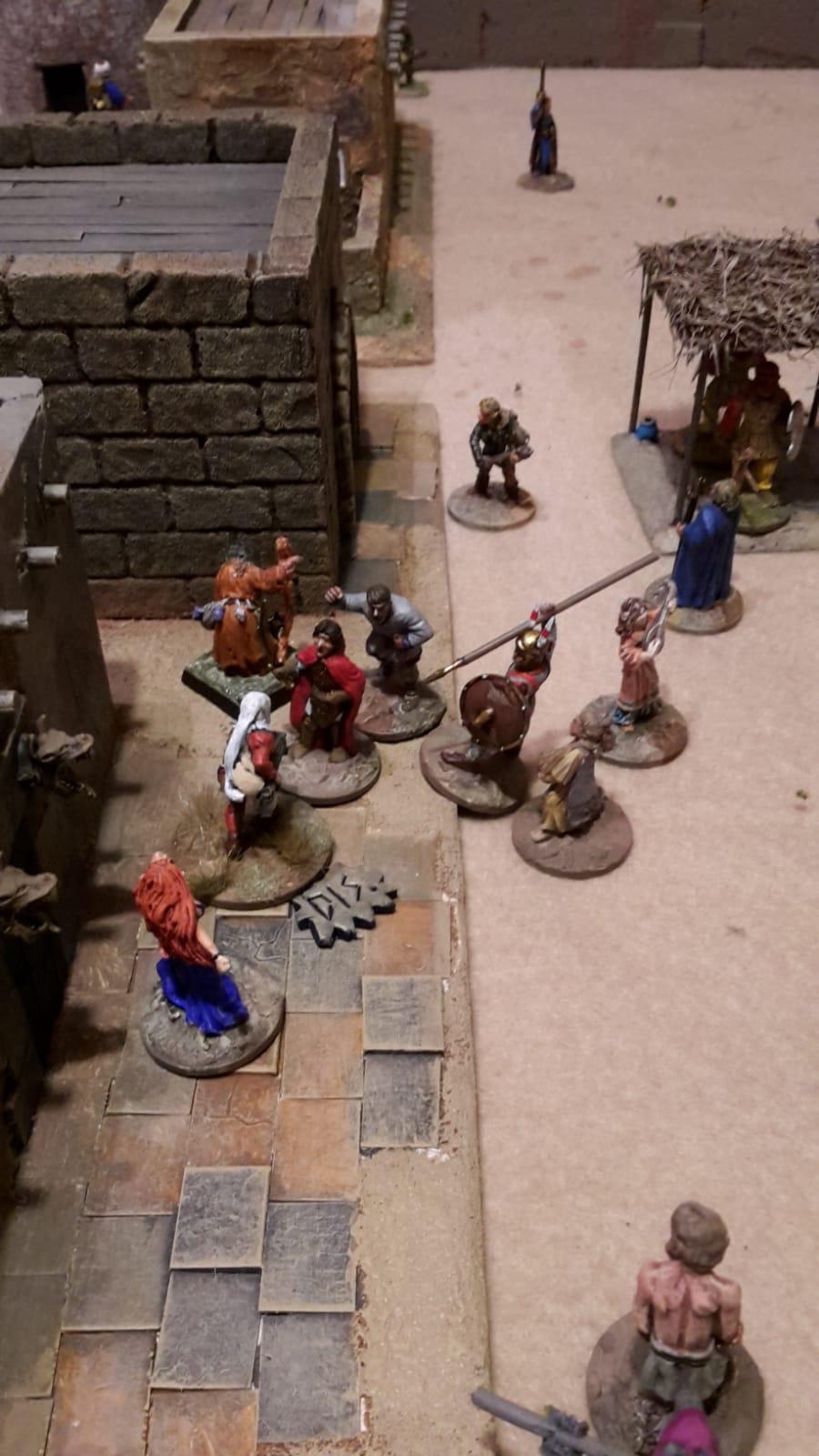
At the start of the game there were two Silver Shield peltasts in the small guard post. Jaxarte, accompanied by his bodyguard, was asking them for directions. Several street-gang toughs were converging on the scene.
In the first action of the game, the red-and-white-clad tough threw a rock at Jaxarte. Jaxarte objected to this and went over to speak firmly to the miscreant.
He was set upon by two of the street-gang and a scuffle ensued. Because this was meant to represent a street-fight in which neither side was particularly trying to kill the others, I'd declared in advance that "kills" would become "knocked out" and that only "gruesome kills" would actually result in the death of a model (but they'd still have the morale effect of a gruesome kill).
Unfortunately it seems Jaxarte didn't get the memo. Tom rolled a six and Simon a one and suddenly the local tough was on the ground gasping his last breath! So much for the Lunars' "don't kill anyone" objective!
This resulted in morale tests for the remaining street-gang members, several of whom run away from the immediate scene thus allowing the Lunars to identify them. The peltasts launched a pursuit...
At this point another three peltasts entered the board from the lane adjacent to the guard post.
As time went on, the Lunars were beginning to get the upper hand. With a bit of helpful die rolling the peltasts were beginning to acquire a decent collection of unconscious thugs.
Although the thief was able to stagger to his feet, he decided the jig was up and ran off, disappearing into a gathering crowd of onlookers. (In reality he rolled three fails on the morale test that resulted from the street-gang losing half its members.)
In the end, then, both sides had failed to achieve their objectives so a draw would be called except that Jaxarte hadn't drawn too much attention to himself by summoning powerful magical entities in the street so a Lunar victory was declared.
The Lunars have one win and are on their way to achieving their strategic aims - whatever they may prove to be!
A Pavis street-gang had been hired to clear the Lunar street patrols away from a particular location from which a thief could enter a target building (for purposes unknown to the gang but they were paid well).
The Lunars had to protect the nobleman who just happened to be in the area and not kill anyone (on either side) in the process. The Lunars could turn a draw into a victory if the noble (Jaxarte Whyded, Commissioner of the Census) managed not to draw any attention to himself by summoning either his Lune or his ancestor spirit.
Tom played the Lunars as it was an excuse to use one of his many silly hats:
Simon and I announced that we were OK thanks very much.
The game covered a single street and its surrounding alleys in New Pavis.
I gave Simon control of the many civilians dotted around the board. They wouldn't fight and were hard to get moving (Quality 5+) but they did offer the possibility of slowing down the Lunars. Any time two or more civilians were within Short distance of each other, they formed an area of Bad Going that slowed down the Lunar troops (but not the street-gang, all of whom had Streetwise - my home-brew Special Rule that allows models to ignore Bad Going in the city).
At the start of the game there were two Silver Shield peltasts in the small guard post. Jaxarte, accompanied by his bodyguard, was asking them for directions. Several street-gang toughs were converging on the scene.
In the first action of the game, the red-and-white-clad tough threw a rock at Jaxarte. Jaxarte objected to this and went over to speak firmly to the miscreant.
He was set upon by two of the street-gang and a scuffle ensued. Because this was meant to represent a street-fight in which neither side was particularly trying to kill the others, I'd declared in advance that "kills" would become "knocked out" and that only "gruesome kills" would actually result in the death of a model (but they'd still have the morale effect of a gruesome kill).
Unfortunately it seems Jaxarte didn't get the memo. Tom rolled a six and Simon a one and suddenly the local tough was on the ground gasping his last breath! So much for the Lunars' "don't kill anyone" objective!
This resulted in morale tests for the remaining street-gang members, several of whom run away from the immediate scene thus allowing the Lunars to identify them. The peltasts launched a pursuit...
At this point another three peltasts entered the board from the lane adjacent to the guard post.
I should mention at this point that the thief had started at point A in the picture below and was trying to get to B. Unfortunately, Tom had chosen to put the Lunar entry point at B too. This meant that the area Simon needed to clear of Lunars was crawling with them.
As time went on, the Lunars were beginning to get the upper hand. With a bit of helpful die rolling the peltasts were beginning to acquire a decent collection of unconscious thugs.
Simon had sent the thief around the end of the table and was about to turn the corner and head for his objective when Tom suddenly rolled three activations for one of his peltasts. This keen soldier rushed up to the thief and beat him to the ground.
Although the thief was able to stagger to his feet, he decided the jig was up and ran off, disappearing into a gathering crowd of onlookers. (In reality he rolled three fails on the morale test that resulted from the street-gang losing half its members.)
In the end, then, both sides had failed to achieve their objectives so a draw would be called except that Jaxarte hadn't drawn too much attention to himself by summoning powerful magical entities in the street so a Lunar victory was declared.
The Lunars have one win and are on their way to achieving their strategic aims - whatever they may prove to be!
Sunday, June 16, 2019
People of Pavis - the Lunars
I'm running the first game of my long-planned Song of Pavis Campaign on Monday evening. That's the name I just thought up for Song of Blades and Heroes skirmishes in that ancient city on the River of Cradles.
Needing some figures to populate the city, I've been repairing and repainting loads of old generic fantasy figures and building a few new models from various plastic ancients. Here are a few of the characters to be found in and around my Pavis:
Jaxarte Whyded was created by Mike (MOB) O'Brien as the protagonist of a series of "travelogue" articles in Tales of the Reaching Moon magazine. His role as Commissioner of the Census required him to visit many parts of the Lunar Empire. The figure is an old figure of Alan Slater's that I recently repainted. In the process I carefully bent his sword into a Lunar scimitar.
Sister Ulara of the Whirling Blades is a member of a Lunar martial arts society/cult. She's an old Lance and Laser Models miniature.
Vanides is the bodyguard to Jaxarte Whyded. He's a steadfast warrior but he's over fond of looting the bodies when he should be keeping an eye on his employer. He's a recent construction based on a Gripping Beast plastic Late Roman with a republican Roman head and a Games Workshop shield.
I needed a Lune, a Red Moon elemental, but they are a feature of Glorantha whose appearance I've never been sure of. The Miniature Adventures in Glorantha Facebook group provided a number of helpful ideas. In the end I decided to use an old Games Workshop figure I've had lying around unpainted for years. I think it may be another one Alan left with me when he went off to Japan twenty-something years ago. Layers of red-pink dry-brushing were aimed at simulating a red-moonlight glow, including on the base but I don't think the latter works too well. Maybe I'll revisit it one day.
I needed an ancestral spirit (I'm not revealing why until after the first game at least). The figure above is another old GW mini with progressively lighter dry brushing. Edit: No it's not; it's a blue wash over white undercoat!
Finally for now in our review of Lunar residents of the New City, here's Erisina. She's a skilled swordswoman and not someone you want to get on the wrong side of. This is another Lance and Laser model originally marketed as Jar-Eel the Razoress.
I'll post pics of some members of the other factions later. I may also reveal the SOBH stats of these and other models but only after they've first revealed their secrets in the campaign.
Needing some figures to populate the city, I've been repairing and repainting loads of old generic fantasy figures and building a few new models from various plastic ancients. Here are a few of the characters to be found in and around my Pavis:
![]() |
| Jaxarte Whyded |
![]() |
| Sister Ulara |
![]() |
| Vanides Moondance |
![]() |
| Lune |
![]() |
| Ancestor Spirit |
![]() |
| Erisina of Peldre |
I'll post pics of some members of the other factions later. I may also reveal the SOBH stats of these and other models but only after they've first revealed their secrets in the campaign.
Wednesday, June 12, 2019
The Streets of Pavis
Having finished another building for Pavis, I thought I'd have a go at seeing what kind of set-up I could put together.
Mixing in adobe buildings originally intended for Mexico and a couple of other suitable structures, I can field a believable two foot square chunk of the New City...
The structure in the fore-ground below is attempt at modelling one of the small guard-posts scattered around the city by the Lunar occupiers. It's made from cocktail sticks and has a plant-frond roof made from fibres from a coir doormat.
My plan is to make more terrain pieces that will do for either Prax or Mexico. With one of the key Praxian terrain types being chaparral, it seems likely that the two are a good match.
The new building (see above and below) is a two-part structure with a mud brick part built onto a stout structure made of mortared stones. I've decided that the roofs of a couple of the structures are too dark. More dry-brushing to follow!
Oh, and the base board here is the one I use for twentieth century games. I'll be using a paler desert-coloured board for actual games.
Subscribe to:
Posts (Atom)