Showing posts with label Napoleonics. Show all posts

Saturday, May 30, 2026

Sharp Practice terrain sources

On Friday Baroness Counterpane and I were at Welbeck Abbey in Nottinghamshire to see our daughter give a talk about the history of the estate's private fire brigade. 

The talk, a ticketed affair, took place in the Harley Gallery and while we were waiting for it to start, my eye was taken by a seventeenth century oil painting.


Apparently 'View of Antwerp' has been attributed to a number of artists including the elder Breughel and Peter Paul Rubens. What caught my eye, though, was the foreground detail.

When building terrain for northern European Sharp Practice games this kind of thing is gold dust.

This one, for example, has a nice old cottage with washing drying on the grass outside, a field of enormous cabbages, and a couple of fence lines overgrown with long grass...


While this one has a wonderfully tumbledown fence...


...as well as a nice little chapel.

Finally this one shows an interestingly wide street as well as a nice selection of outbuildings.  


Worth noting by the way that at least one of the horses towing the wagon in that last section is hitched centrally. That's going to be pretty typical. It's my belief that the country lane we're familiar with today, with its central strip of grass between two channels of bare earth, is an artefact of the internal combustion engine. It shouldn't be seen in horse-and-musket-era or earlier terrain.


Tuesday, October 21, 2025

Do you know the way to Rīga please?

A few hours playing with leftover bits has given me a piece of location-suitable scatter terrain for the Livonia 1812 campaign.


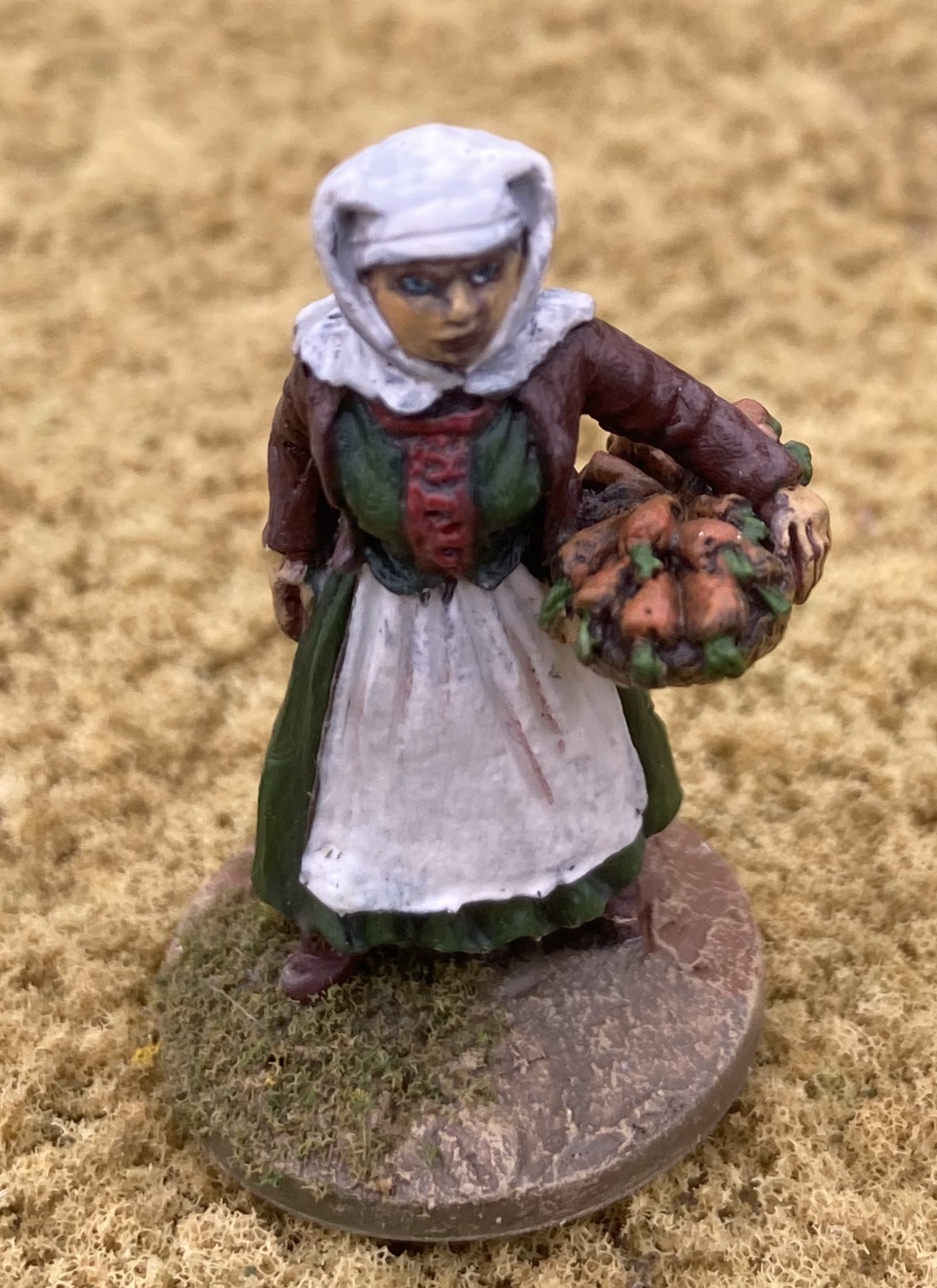
Here we see a peasant woman standing next to a distantsionnyy stolb or distance post. This would give the distance (in postal miles) to various cities.

Here's a preserved one:


I made mine from some MDF "sprue" left over from a building kit. The top was carved to a shallow pyramid shape and the name boards and ground-level socket were made from thin card. The base is another piece of MDF with the edges chamfered down and coated with filler. 

My stripy pattern isn't quite the same as the preserved one but I think it works. A little static grass around the pole completes the picture.

Here we see some French-allied Prussians marching past while Colonel Têtard-de-Crapaud, the French master spy, reads off the distances.


An alternative situation, allowed for in my Livonian Scenario Generator, is that withdrawing Russian troops have chopped down the post and hidden it in the forest to avoid giving information to the invaders.


This version of the post was a lot easier to build! I simply made angled cuts into a similar piece of MDF to simulate axe blows before snapping it off. The same card socket and ground work complete the piece, much to the Prussians' frustration.


Wednesday, October 15, 2025

A bit of shopping

Having got Steel Lard out of the way, the Baroness and I popped up to North Yorkshire for a couple of days. 

After perusing the bookshops and charity shops of York I came away with a little Napoleonic reading matter.


I'm gradually building up a nice little collection of Napoleonic memoirs; all good sources of narrative snippets.

I also found a Charlie Wesencraft wargaming book in an antiquarian bookshop on Micklegate but neither you nor I are allowed to see it at this stage because it's my Christmas present! Hopefully I'll have forgotten about it by then and it'll be a lovely surprise.


Tuesday, September 30, 2025

Making the most of spare parts

Since I first got into making models as a kid I've always followed the advice (from books and magazine articles) that you should hold onto any unused kit parts. You never know (goes the theory) when they might come in useful for later conversions. I have boxes full of bombs, missiles, undercarriage components and other parts from Airfix and Matchbox kits that I completed (or in some cases didn't complete) in the 1970s and 80s!

With the advent of 28mm plastic soldiers from the likes of Victrix, Warlord Games, Perry Miniatures, and Gripping Beast I now have a multitude of limbs, bodies, and heads awaiting a future use.

Manufacturers want to make their sets as flexible as possible so you aren't limited to building a single type of unit from a given set of sprues. As a result they often provide multiple options for particular parts.

The Warlord Games War of the Spanish Succession Cavalry box is an example here providing heads with tricorns and cuirassier helmets and alternative torsos (torsi?) with armour or in a variety of unarmored uniforms. Coupled with bits from other sets, the extra bodies have contributed to my American Civil War armies as reported here and here.

The ACW figures are generally produced by sticking together existing parts in new ways. The amount of surgery needed to change an arm holding a sword into one holding a revolver is not beyond any modeller's capabilities, particularly as hard plastic figures can be cut with a craft knife and glued securely with liquid polystyrene cement.

The next stage in using spare parts is to try some more advanced surgery.

Having bought some Perry Miniatures French Napoleonic Hussars 1792-1815 to act as the basis of French contre-guerilla cavalry in Mexico, I had enough parts left over to cobble together a wounded French hussar officer for my A Spy in the Suburbs Sharp Practice game.

This involved taking modelling tools to a pair of overall-clad hussar's legs. After carving off the stirrups and associated straps (not done in the picture below) a number of cuts were needed on each side. First the green cut took the leg off at the groin. 


Next I made a cut at the level of the knee (turquoise line) and bent it outwards to remove the slightly bow-legged effect. A bit of plastic filler and maybe a small piece of plastic card to wedge open the cut were used to repair the join.

Next I removed a wedge of plastic (between the two red lines) and glue the leg back on; effectively gluing the two red lines together. When that was set, I rebuilt the outer thigh with Green Stuff. Because the "red wedge" was half the width of the thigh, the effect was to preserve the overall length of the leg.

With the other leg done in a similar way I had a reasonable standing figure.


In this case I didn't have a hussar torso but I was able to make a figure in shirtsleeves using a body from the Warlord WSS Cavalry set and a pair of ACW arms. A hand with a pistol from the Warlord set, a scabbard, sabretache an busby-ed head from the Perry Miniatures French Napoleonic Hussars 1792-1815 box completed the picture.

The Perry Napoleonic Allied Cavalry box is particularly guilty in terms of providing an excess of body parts. Because it includes parts to make both Russian and Prussian dragoons in short jackets (Kollet) or longer coats (Litewka) the box contains enough parts to make twice as many riders as there are horses!

I've used similar techniques on this set to produce some dismounted Russian dragoons...


The running figure was made by cutting one of the legs at the knee, again removing a wedge of plastic, and rebuilding the front of the knee with Green Stuff. The arm with the musket is an ACW infantryman's with the bayonet carved away.

Finally, I've built a Prussian Deployment Point base using the same set and similar techniques.


The figures are gathered around a chess board (plastic card with tiny pieces of fine plastic rod) glue onto a 3D printed tree stump. A 3D printed anvil provides the seated guy with somewhere to perch.

The two bare heads are stolen from Wargames Atlantic's Citizens of Rome set. Shakos were carved from unused heads and glued to the base beside the two bare-head guys.


Wednesday, May 7, 2025

Sharp Practice Scenario Generator

Regular readers of this blog (I know there are a few of you) will know that I've been working towards  a mini-campaign set during the 1812 French invasion of Russia. Rather than going with the well-known march to and retreat from Moscow, the plan is to cover Marshal Macdonald's advance towards Riga with a corps made up almost entirely of German and Polish troops.

Inspired by the approach used in Osprey's Rogue Stars sci-fi skirmish rules, I decided to have a go at a random scenario generator for the campaign. The following system doesn't try to establish every single detail of a scenario. Instead treat it as a source of ideas; you'll still need to nail down some of the details by agreement (if you don't have an umpire).

To generate a Sharp Practice scenario, start out by rolling a D20 to get an idea of the general terrain on the table:

If a village shares the table with terrain that precludes farming, eg forest or boggy ground, the village is (or was) inhabited by Jewish traders and artisans. They are used to being attacked so their caches of food are well hidden. Add 5 to the foraging Task Values.

Next we need to roll twice (once for each side) to see what orders our respective detachments have been given:
Finally roll once on the Complications Table to find those unpredictable items that make life even more, well, complicated!
These tables reflect the Narrative Snippets I've captured while reading contemporary accounts of 1812 and other campaigns in Napoleonic Eastern Europe. I plan to treat this as a living document and add to or amend the plot elements as my reading continues.

There's no reason this approach can't be adapted for other campaigns in the Napoleonic era or at other times.


Tuesday, January 28, 2025

1812 Rescue Mission

I managed to occupy the kitchen table this morning and play through, solo, the Sharp Practice scenario I designed recently. 

It's June 1812 and the "French" corps commanded by Marshal Macdonald has crossed into the Russian province of Livonia. The corps is made up largely of German and Polish troops who, now freed from restrictions on foraging in friendly villages, hope to fill their empty bellies. 

Leutnant von Hitwunde leads a small force of Prussian infantry to search a village near the army's line of march. He is aware that Captain Früschli, a rather foppish Bavarian officer attached to the General Staff, has ridden on ahead intending to use the church tower as a vantage point. He plans to sketch the countryside over which the army must march.

As his column, slowed by a waggon to carry off gathered supplies, draws near to the village, von Hitwunde spots a small patrol of Russian dragoons riding toward the village. Given the angle of their approach, they will be invisible to Früschli because of a large tree beside the church tower...

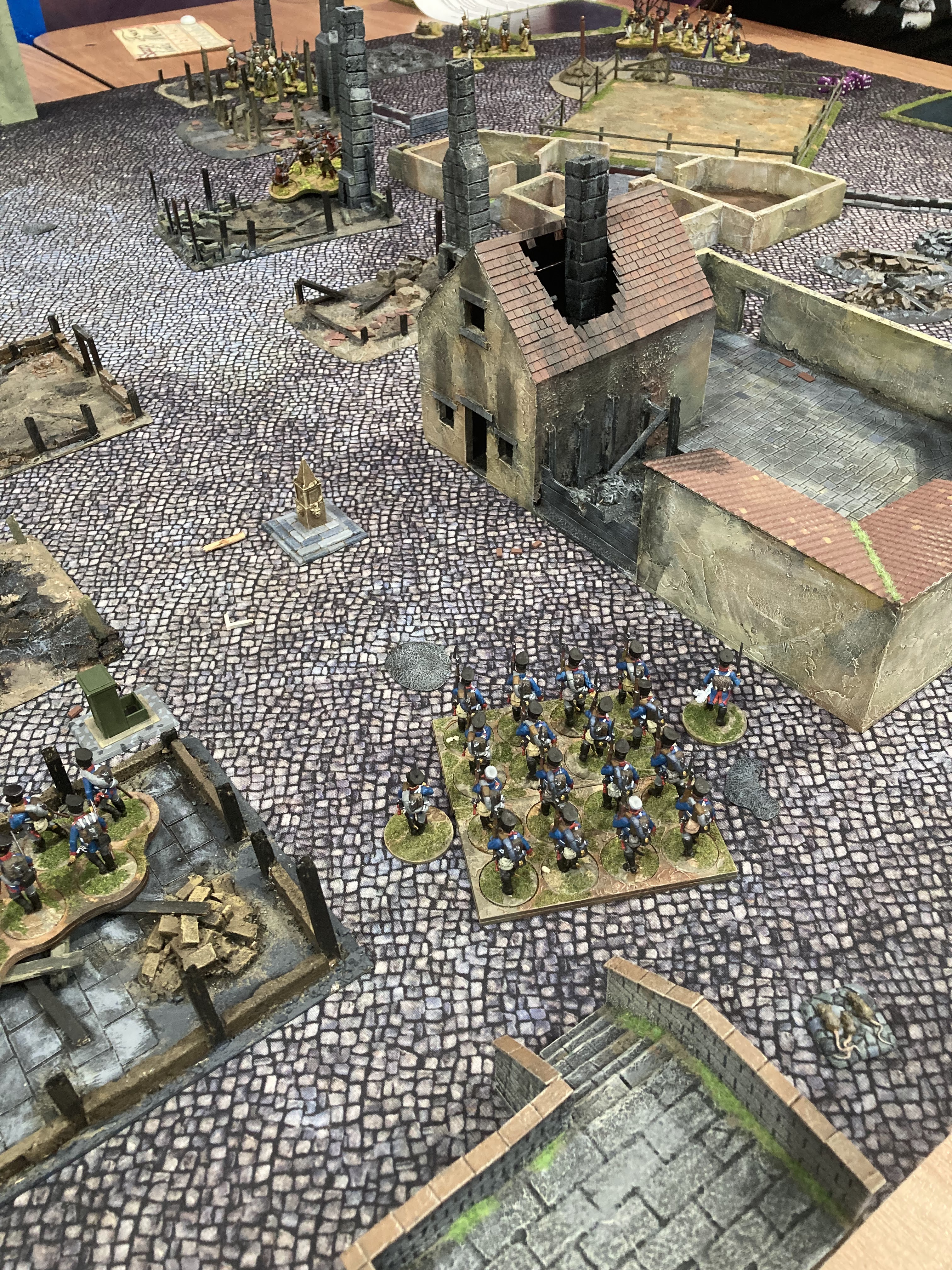
The battlefield - the Prussians enter on the road
bottom right. The Russian Deployment Point is just visible
behind the trees on the right edge of the table.

Turn 1 went just about as poorly as it could for the Prussians. The Russian dragoons' card came up first only to be immediately followed by the Tiffin card. The dragoons were deployed nine inches onto the table with the small woods on their left.


Turn 2 saw card Blue 2 come up first. This represented the Prussian NCO. I decided that the Prussians would send him off with one Group of infantry to wade across the stream and advance on the village in a right hook. As things would turn out, this would be completely ineffective. Having run up to the stream (picking up a point of Shock) they would spend the next six turns rolling appalling movement dice and struggling to cross the stream!

Also on turn 2 the Russians continue to canter towards the door of the church. 

I treated the single Bavarian standing guard as a one-man infantry unit. Activating on a Flag card after Tiffin, he stepped into the open and fired his musket at the approaching cavalry. He was obviously panicked and the ball flew wide.


Turn 3 saw Lt von Hitwunde arrive and lead his men in column along the road towards the bridge.


After an early Tiffin card, I decided the Russians would want to take out the sentry before he managed a lucky shot. I used a Flag to activate them and they charged the still-reloading Bavarian.


Faced by charging impact cavalry and with an unloaded musket, the Bavarian was cut down without inflicting any casualties on the Russians.

Turn 4 saw one Flag card each and then Tiffin. The Russians used theirs to dismount at the church door. This gave me the chance to use some dismounted dragoon figures I built out of left-over parts from the Perry Allied Cavalry box...


... and von Hitwunde's men continued their march along the road.


Turn 5 began with a Random Event that saw the Prussian column, with spring in their step, surge forward onto the bridge...


... with the accompanying waggon now lagging behind.


Needing to catch the Russians before they disappeared into the church, Von Hitwunde decided to act. Spending three Flags to move out of sequence he urged his men forward. Rolling a 6 on a single move die, the front of the column rounded the end of the riverside woods and loosed a volley into the dragoons killing one of them and inflicting three points of Shock.


At this point, finally, the card for Captain Früschli, the Bavarian officer came up. I decided he would attempt to progress his sketch of the countryside. One roll of snake-eyes later, he was two-twentieths of the way through his Task!

On a Flag after Tiffin, the dragoons retreated into the church.

Turn 6 was brief; a Russian Flag and then Tiffin. I decided the Russians could use the Flag to barricade the door as long as they didn't roll snake-eyes. This they avoided, slamming home the bolt with a satisfying clang.

On Turn 7 things began to go wrong for the Russians. Their Leader, serzhant Majevskii's card came up first and he rallied off two points of Shock in preparation for an assault up the staircase to try and kill or capture Früschli. 

Unfortunately, the next thing that happened was a Random Event. As the last activation was the Russians completing the task of locking the door, the rules suggested that this had failed. There must have been rot in the wood where the screws held the bolt in place. With an ominous creak, the door slowly swung open!

After that the Tiffin card came up. The Prussians used a Flag to reload.

Turn 8 began with von Hitwunde's card. He launched the men into a charge but they were unable to reach the door before the Russians finally got it barred. Elsewhere Feldwebel Klopp's men finally got across the stream, far too late to make a contribution to the action.

Turn 9 saw the action reach its climax. The Prussians assaulted the church. I resolved this as a round of Fisticuffs with the Prussians deemed to be assaulting a major obstacle and the Russians to be defending a high/wide one. 


The results were decisive; for the loss of one man, the Prussians inflicted three casualties including knocking out Majevskii and inflicting a second point of Shock. Added to the two additional points of Shock received for "losing by two" this was enough to rout the Russians. The two survivors fell back 15", I assume having broken through the east window of the church.


The game was great fun; I really enjoyed how the narrative pretty much wrote itself. It's good to know that von Hitwunde survived and can take his place in the campaign proper when Richard P and I finally get round to playing it. Perhaps the captured dragoon sergeant will play some role in our first game?


Thursday, July 6, 2023

Another clear-out

I thought it would be a big emotional wrench but when I came to it the decision to sell off my 20mm Napoleonics was surprisingly easy. I far prefer the look of 28mm for Sharp Practice games and if I ever do big battle Napoleonics it'll almost certainly be in 6mm.

Yesterday I dug out the French to photograph them prior to putting them on eBay.


They are a from mixture of plastic manufacturers with a few old metals thrown in too. The main body is made up of six groups of eight infantry (one of them grenadiers) with accompanying officers, NCOs and drummers.


Then we have a unit of eight hussars, again with a leader, one of M. Larrey's ambulances, and some senior officers. I have some dragoons somewhere too. I need to dig them out and add them to the pile.


There are also three groups of six light infantry chasseurs with officer, NCO and drummer, three units of Nassauers (one of them grenadiers) with officer, musician and casualties, and two French gun batteries.


As I said, these are to go on eBay but I thought I'd give you guys the chance to make an offer on them first. I don't have a price in mind at present but I thought I might put them on eBay with a minimum bid of £50.


Friday, March 31, 2023

Out in the Fields

At Vapnartak last month I bought some Eastern European peasant figures by Bifröst Miniatures from the Warbases trade stand. I thought they'd probably come in useful for our planned 1812 Sharp Practice games.


When designing scenarios for either of the Too Fat Lardies narrative-focussed, large skirmish systems (Infamy Infamy and Sharp Practice) it's helpful to have civilians available as plot devices. They can be maidens in distress, sources of intelligence on enemy movements or just a source of player paranoia! 

A maiden - not currently in distress

What do these guys know?

Do these count as Big Choppers?

The figures were enjoyable to paint and I reckon they'd work for Eastern Europe right into the twentieth century. Actually, at least some of them might serve as European immigrant farm workers for ACW games.

Monday, January 23, 2023

Bookshop finds

A recent trip to a local second-hand bookshop (the one where I got the Battles and Leaders of the Civil War set) produced a fine haul of reference material.


The Civil War in Art - A Visual Odyssey by Doranne Jacobson is a coffee table book full of reproductions of paintings and photographs of the ACW. I thought it would be useful, if nothing else for the portrayals of civil war battlefields to support terrain building.

The Union Cavalry in the Civil War by Stephen Z Starr is a well-researched and densely footnoted study of the subject and I'm already a chapter into it. The narrative as I understand it is that Union cavalry is initially outclassed by their Confederate counterparts but that with experience and Sharps breech-loading carbines, they eventually come to dominate. I'll be interested to see if this turns out to be the case.

Finally, Russian Eyewitness Accounts of the Campaign of 1814 by Alexander Mikaberidze is a couple of years out from the 1812 mini-campaign Richard Phillips and I are working towards but it's got to provide some useful insights, surely?

Fifteen quid for the lot strikes me as tremendous value for what must be fabulous Sharp Practice research material.


Tuesday, November 22, 2022

Steel Lard 2022

On Saturday fifty-odd wargamers (fifty odd wargamers?) gathered at Patriot Games in Sheffield for the third annual Steel Lard gaming day. We had twelve games in total from across the Too Fat Lardies catalogue. In no particular order:

Sidney Roundwood provided the smallest game with his The Lost Sword of Lord Akiyama. On a table only eighteen inches square, this game used Sid's own When the Last Sword is Drawn - a Lardy-style Samurai skirmish system. As usual with Sid's games, the presentation was excellent:


Thick as a Brick was Jeremy Short's game. Run using an adapted version of Dux Britanniarum, it featured Robin Hood, the Sherrif of Lardingham, Friar Tuck, and the minstrel  Jethro Tull. Jamie really enjoyed this game in the morning and I believe Friar Tuck was sent to meet his maker.


John Savage can always be relied upon to produce a good-looking and immersive game. This time it was The Sands of Shah Wadi Wadi, a Mahdist Revolt-themed game using the Sharp Practice rules with some adaptations to cope with repeating rifles and later-nineteenth-century tactics.


Also run using Sharp Practice was my own A Spy in the Suburbs the development of which you'll have seen documented here over recent months.  That this was the first running of the game with the intended Russian figures was due to the heroics of Richard Phillips, who got off his sickbed to drive them over the Peak District from Staffordshire. Richard, if you were a Hordes of the Things element you'd have a combat factor of +5 and would always count as mounted.


It was a tremendous pleasure to run the game with such enthusiastic players.


In two run-throughs, the French spy was captured by the Russians on the first occasion and managed to escape to the Prussian lines in the second game.

On the next door table I also "ran" A Bridge Too Far Up River, a Woebetides Sharp Practice scenario that had previously seen the light of day at Virtual Lard in July 2020. 

Originally Richard Clarke had been scheduled to run a Chain of Command game but recent health concerns led to him withdrawing. We decided to take advantage of Richard Phillips being semi-available (he and I were going to work together on the Riga game) and have him run a Woebetides Sharp Practice scenario of his own devising.

Unfortunately as we know, Richard P went the way of Richard C when he contracted a nasty gastro-bug from his grandchildren. Fortunately I'd already printed off the player briefings for the old scenario and put enough terrain in the car just in case.

Great honour is due to the allocated players who demonstrated good humour in running their own game as I was inevitably focussed on the more complex Riga game.


Jim Catchpole and Simon Mann in particular seemed to relish the opportunity to get to grips with learning Sharp Practice. Thanks guys!

If Sid's game was the smallest in the venue, Ken (Yarkshire Gamer) Reilly's game was definitely the biggest. Using the less-well-known If the Lord Spares Us First World War set, Ken ran the battle of Um At Tubul from the Mesopotamian campaign. This was a single game run throughout the day and seemed very popular with those involved.


Also in a Middle East setting was Graeme Atkinson's A Box Near Tobruk. This used Chain of Command rules and lovely terrain to simulate an Italian attack on a defensive position near that beleaguered North African city. 


Graeme's expert modelling captured the dry desert so well that it was like watching an episode of SAS: Rogue Heroes. I expected to hear the strains of AC/DC at any moment!


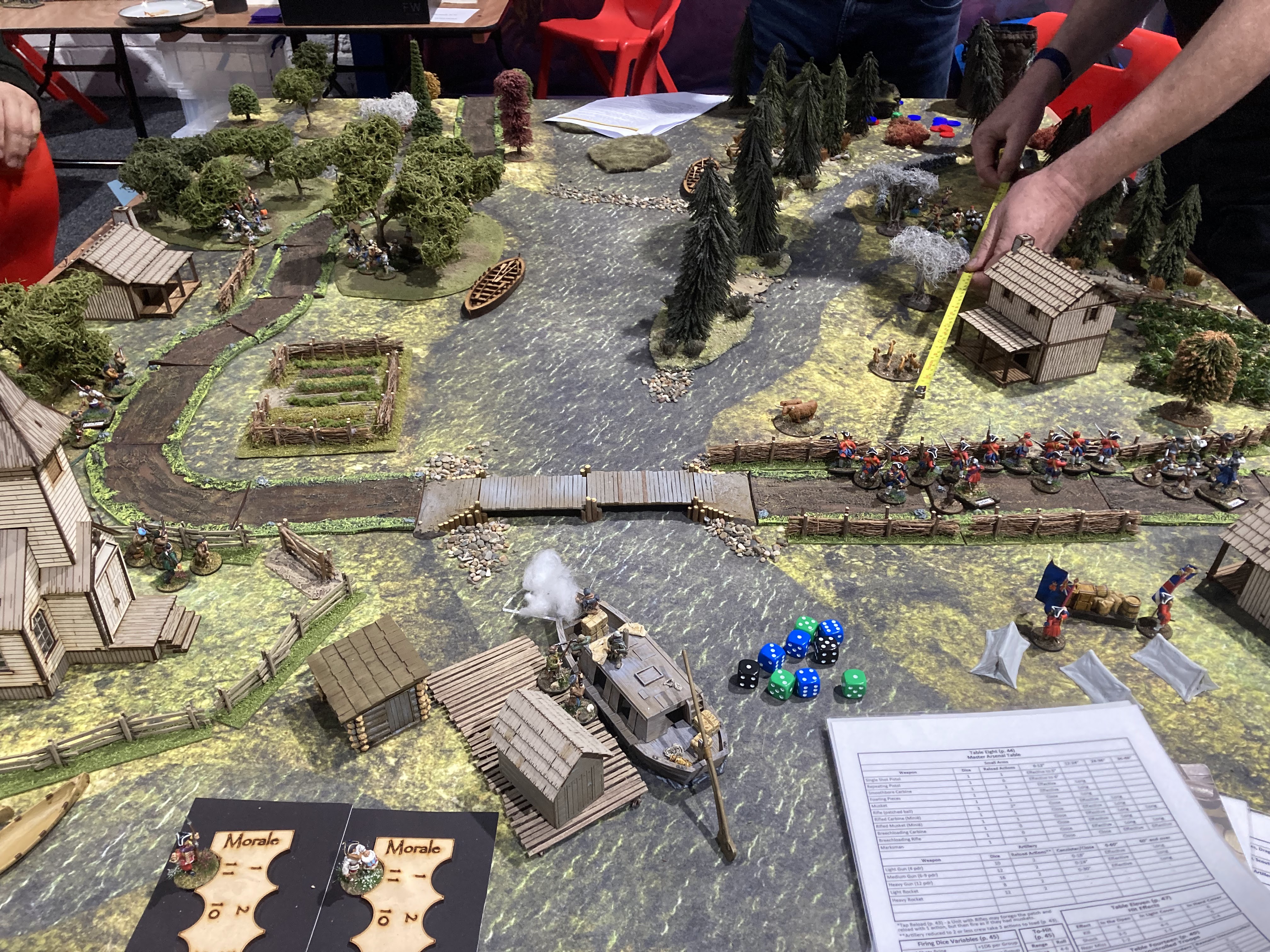
Meanwhile, back in the temperate north, Ken Welsh ran Mission to Croquette - another Sharp Practice game, this time set during the French and Indian Wars. 


I believe this may have been Ken's first time running a game at an event. If so he did a great job!

Alex Sotheran ran Up the Arras: Bloody April 1917. As the name suggests this was a First World War scenario, in this case using the Algy Pulls It Off variant of the Bag The Hun aerial dogfighting rules. 


Unfortunately unphotographed was Tom Davis's Havana Take Your Island. In my defence this game didn't actually involve anything to photograph. Set during the Seven Years War, this was a Kriegspiel - effectively a role-playing game - about British efforts to capture the island of Cuba from the Spanish. Tom spent most of the afternoon running about between multiple tables where different national command teams were based. I've had some really positive feedback on this one.

There were two more games that I'm afraid I didn't get pictures of as they were only run during the morning session and had been put away by the time I finished in Riga.

Charley Walker ran Red Hot Frigate Action off Le Coup de Cheveux, 1795. This was a Kiss Me Hardy game with Charley's really nice French Revolutionary War ships.

Finally, Mike Wilkins ran The Eagle Has Larded - a Chain Of Command game based roughly on the old TV series Allo Allo. Again, I didn't get to see this much but it was great that Mike stepped into the mix late on to allow some of the other games masters to spend some of the day playing rather than refereeing.

As a new venue for Steel Lard, Patriot Games was very well received. The gaming space is pretty much ideal, the in-house café is excellent, and the staff were uniformly terrific. Only the presence of on-site parking could have improved things and as we didn't have that at the previous venue we didn't miss it too much.

In the evening we enjoyed the traditional beer and curry. This may be the subject of work to improve next year's offer but it looks like I may be organising the event again in 2023!