Showing posts with label 20mm. Show all posts

Sunday, October 4, 2026

Upgrading past endeavours

Getting Steel Lard (and the associated mad rush to prepare and test a new game in too short a period) out of the way has freed me up to do some modelling purely for the fun of it. 

The French 1940 artillery tractors have already appeared here and some upgraded US HMMWVs were recently seen over at Andreivian Tales.


Inspired by how well those two went, I pushed on and did two more as well as an M113 armoured personnel carrier.


I've also upgraded some very long-in-the-tooth Char B1 bis models that have been in storage for far too long.


I'm in no danger of winning any points with the local IPMS chapter with any of these but I think they'll improve the overall appearance of any games I use them for.

This has got me thinking about past triumphs (and disasters) and how we really ought to revisit some of them to get best value out of the sweat and treasure invested in them. The Prague Summer, Andreivia and the Woebetides are three settings that I'd like to resurrect and I'm pretty sure I'm not alone in that.

I suspect a Crisis Point 2027 is going to required. 


Monday, September 21, 2026

French transport, 1940

Given a bit of spare time yesterday, I dug out an old toy and converted it into some transport for my 1940 French in 20mm scale.

I started with an old Lesney die-cast Scammel recovery vehicle with a broken towing arm. Some carved balsa wood and glued-on tissue paper gave it a canvas-covered rear platform. I think it looks like a reasonable approximation to a French artillery tractor, perhaps something from the Laffly company?


As you can see, there are two. The one on the left, above, I made about twenty years ago by a similar method. The colour matching isn't perfect but I'd think canvas tilts in particular would vary in colour.


I've no plans to use these at the moment but it's nice to know the second toy is no longer sitting in a box waiting for me to do something with it.


Friday, May 15, 2026

Finally, a Fairey Delta 2

Following shortly on the recent Jet Provost model, I've completed a kit that's suffered a very chequered past.

The Fairey Delta 2 was a British research aircraft from the 1950s. In 1956 test pilot Peter Twiss flew one at 1,132 mph, beating the previous world speed record by over 300 mph! Information learned from the aircraft would later inform the design of Concorde's delta wing plan.

I received the Dora Wings 1/72 scale model of the Delta 2 as a Christmas present in 2024. It looked like a challenging model to build as it included photo-etched brass parts, something I'd never encountered before.

Nevertheless I made a start early in 2025 and got as far as completing the main airframe before disaster struck. The front part of the canopy was meant to slot into a cut-out in the sides of the fuselage. However, it was at best a tight fit: as I forced it into place there was a sudden 'click' and a piece of plastic flew off past my head!  

On further investigation it emerged that the windscreen had split in two and half of it was now missing. Failing to find that half I sadly consigned the remains of the kit to its box and accepted that I would probably never finish the Fairey.

But then, a few weeks ago whist clearing the workbench to make room for a large painting job, I came across a small piece of clear plastic. Yes, it was the missing piece of canopy! My Fairey Delta would never be a perfect model but it could at least be finished.


It's far from perfect; I'm not happy with the attachment of the etched-brass wing fences and the long nose probe that survived initial construction and storage got broken in the process of applying the decals! It is moulded as part of the fuselage rather than as a separate part that could be fitted towards the end of the build. I just knew I'd not get through without breaking it but I'm furious to have got so close to the end before doing so!

In posing the thing for these photographs I've also noticed some stray bits of decal that have somehow ended up near the tail. They'll have to come off or be painted over!


Things to watch out for if you're building this beast:
  • the ill-fitting canopy,
  • that delicate nose probe (I never even attempted the tiny, etched-brass airflow probes that should be fixed to it), and
  • for some schemes a yellow stripe decal needs to be added below the nose before you attach the lower aerial and pitot tube.
All in all I don't think the Dora Wings kit is bad; it's just better suited to a more experienced modeller than I am currently. If I saw one going cheap (unlikely) I'd probably pick it up and model one of the preserved aircraft taking advantage of the option to depict the nose in its Concorde-style drooped configuration. 

Sunday, May 3, 2026

Jet Provost

The latest addition to my collection of small jet aircraft in 1/72nd scale is this beastie from Airfix.


It's a Hunting Percival Jet Provost T.4 painted as an aircraft at the Royal Air Force College, Cranwell in 1962.


The model is built straight from the kit using one of the two decal sets provided. The only change I've made is to paint in the red and green navigation lights on the tips of the wing tanks. In the Airfix instructions these are shown as black.


It's an enjoyable kit to build and goes together with only minimal filling and sanding required. The hardest part of the build was the sweeping curve of orange paint under the nose. I couldn't find a way to mask it so I had to handpaint it. I'm pretty happy with how it worked out.

I think I might get another of these kits. The other paint scheme also has a tricky curved demarcation line to paint so I might invest in a pack of Xtradecal after-market decals to finish it.

Tuesday, January 20, 2026

Over at Andreivian Tales...

You can now read the account of the British attack on a ruined fort held by the renegade Turkish officer Iskender Bey at Andreivian Tales.


Friday, January 16, 2026

Return to Andreivia and Arc of Fire

I've managed to persuade a few of my regular drinking buddies to try wargaming for the first time. The plan at present is to have a go at a simple game in a couple of weekends' time. I don't expect to convert any of them to the hobby but it would be nice if they had a frame of reference for our "What are you doing this weekend?" conversations.

I gave them a choice of four games including 4th century Romans vs Picts, 15th century Burgundians and Swiss, and a rerun of my Port Gibson ACW game. In the end, though, they chose an early twentieth century adventure; in fact a return to Andreivia with a scenario I wrote to run about 12 months ago but that fell though the cracks for some reason.

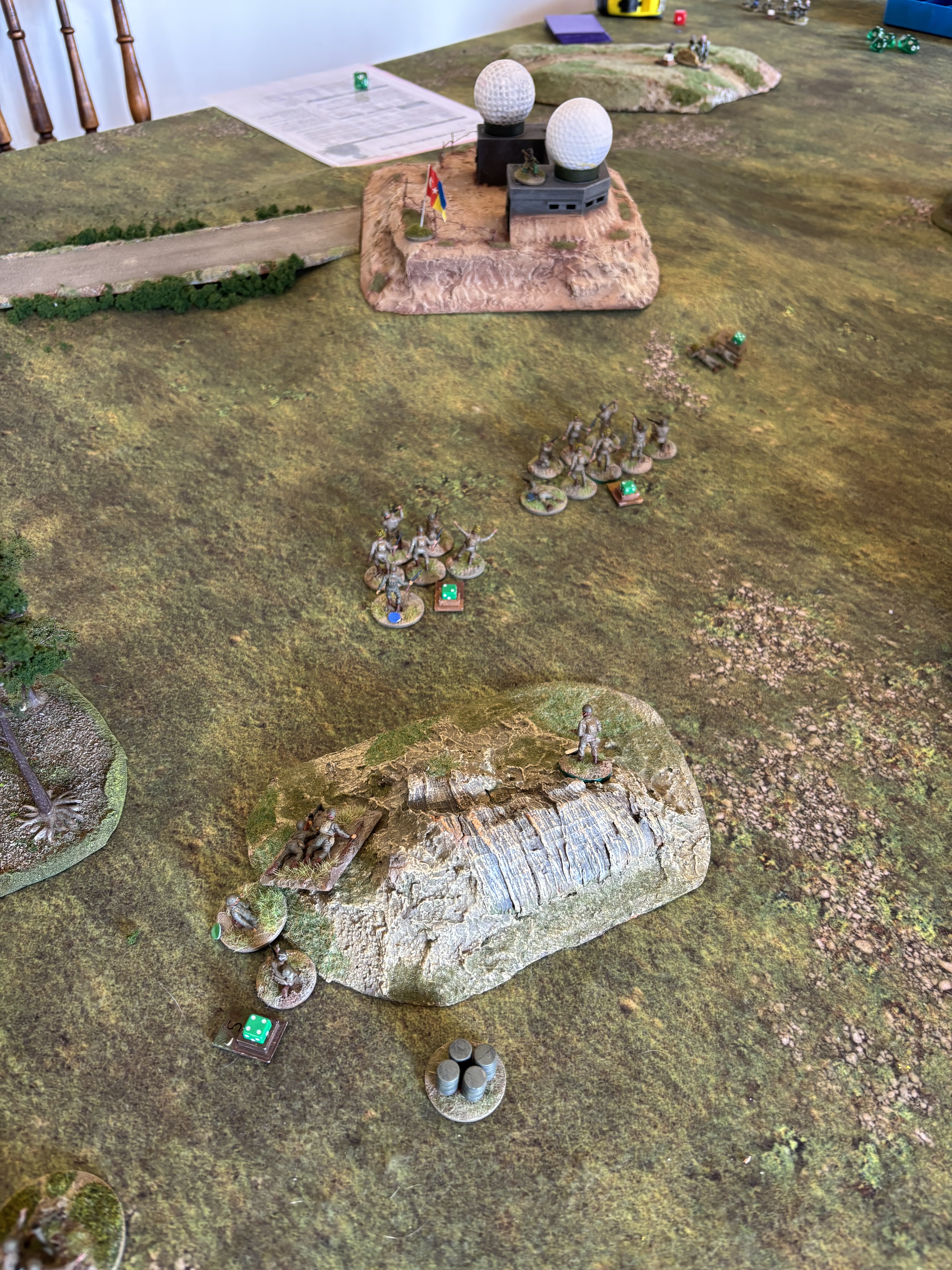
The game will involve a rogue Turkish officer who has gained control of some experimental poison gas shells. Certainly British and possibly Andreivian forces will be attempting to take the gas shells off his hands. Arc of Fire will be the rules in use.

I don't need to build any additional units or terrain for the game but I have today improved the paint-job on this Raventhorpe white metal Laffly armoured car...


Don't go blowing the image up to look at the detail. It's not a great job but pin-washing and dry brushing have lifted it a little.

One reason for including Arc of Fire among the options was that it's a set of rules I can run with my eyes closed. I could consider dropping unit modes and random events from the rules for this game for simplicity. However, to me they are such important factors in making the game a fun narrative experience. 

In fact I'm adding another complication for this one. Certain units, such as the British Mark V tank, have special rules. For the Mark V the rule is:

Poorly Designed:
If subject to red-then-black, make a Tac roll. If failed, the crew immediately abandon the vehicle leaving the hatches open to ventilate out hot air and fumes. Note that they may leave the tank moving and walk alongside it. They may not return to the vehicle for the remainder of this game turn.

The reference to "red-then-black" reflects a new approach I'm trying here. The Mark V tank will normally activate like any other unit. However, if its card comes up immediately after the Red Joker is drawn and the Black Joker has previously been drawn this turn (i.e. the combination of cards that does not trigger a Random Event) the Poorly Designed special rule takes effect.

The idea is to have a trigger that doesn't come up often and that can be used to demonstrate the peculiarities of this particular unit. The Mark V's engine-cooling radiator was inside the fighting compartment and this was a known problem!

That's the rules position, then. I'll post something about the game itself on the Andreivian Tales blog shortly.


Wednesday, December 24, 2025

Review - Rapid Fire! - Third Supplement

I thought it might be useful to produce some reviews of WW2 scenario books with particular reference to their usefulness for TacWWII players.  I propose to rate the books by scoring them from 1 to 5 in each of the following categories:

  • Book Design - layout, illustrations, maps
  • Historical Content - does the book provide useful background?
  • Scenario Design - are they interesting, challenging?
  • TacWWII Relevance - relevance and ease of conversion to TacWWII.

These won't necessarily be newly published books. If you're interested you may have to search some of them out via eBay or your local convention's bring and buy stalls.

First up is Richard Marsh's Third Supplement published by Stratagem for the Rapid Fire! rules. 


The 56-page, softbound A4 book contains 14 scenarios covering the Great Patriotic War. These range in space and time from the crossing of the Bug in June 1941 to street fighting in Budapest in January 1945. The contents are mostly in black and white including maps apparently designed with Microsoft Word back in the distant past. The maps are rather stylised and do little more that show the relative locations of significant battlefield features.

However, the front and rear cover (inside and out) and the centre eight pages feature colour photographs of 20mm scale models on terrain appropriate to the scenarios. While these are clearly posed shots, they are consistent in style with actually gaming the scenarios. These are inspiring, albeit most TacWWII players would need to think in terms of building their battlefields in smaller scales.

For Design of the book I rate this offering at a slightly generous 4/5.

In terms of history, the book contains a potted description of each battle. The background is given as is a brief outline of the historical result and often some notes on scenario design choices made by the author. In addition, a couple of dozen sources are mentioned at the start of the book. 

At the back of the book we get some optional additions to Rapid Fire to capture specific aspects of war on the Russian Front. Obviously these are not directly relevant to the TacWWII player but they do serve to highlight issues the designer thinks are particularly important.   

From a Historical Content point of view the book's perfectly adequate to the task. It does give context to our games - 4/5 points.

The scenarios are generally a little bit same-y in that they tend to be attacker-vs-defender games played along the long axis of the table. However, there are some interesting factors such as "Your ammunition is limited and you can't resupply until you've captured location X" or "You need to rescue a besieged force and then get them back out the way you came".

On the whole I think the scenarios will give reasonable games and a fairly decent impression of the historical situation. I'm going to go with 3/5 points for Scenario Design.

I've spoken previously about adapting scenarios from this book to TacWWII. The conversion of orders of battle from Rapid Fire format is fairly straightforward bearing in mind the slightly idiosyncratic model ratios (1:5 for vehicles, 1:15 for men).

Slightly less easy is the widely varying ground scale used in the mapping of battlefields. Basically you're going to have to do your own research to establish the size and layout of your TacWWII battlefield. For this reason I can't give this book a Usability score any better than 3/5 points.

Overall, then, the third Rapid Fire supplement scores 14/20 as a resource for TacWWII players. If you can find a hard copy and you're into wargaming the Eastern Front, I'd certainly recommend giving this a try. Alternatively you can purchase a pdf copy of the supplement from the Rapid Fire website.

Thursday, December 11, 2025

A first go at airbrushing

I've been meaning for some time to add airbrushing to my arsenal of modelling techniques. It seems particularly necessary as I go further into building model aircraft.

My mate Mark P has had a cheap airbrush and compressor set for some time and we've discussed having a session to play with it but we've never managed to get it scheduled. Recently he dropped it off at Stately Counterpane Manor and urged me to have a go myself.

I had a fourth Airfix Folland Gnat kit in the stash (having already built Red Arrows, Yellowjacks, and RAF Valley trainer versions) and was casting around for a suitable colour scheme for it. The scheme used on the aircraft in the film Hot Shots Part Deux was an option but I wanted something that would use one of the airbrush-specific paints I already own so an overall aluminium scheme was the best bet.

In the end I recycled to decals from an Airfix Vampire T.11 kit to produce a fictional Royal New Zealand Air Force aircraft.


The model was rather rushed as I just wanted something I could apply paint to quickly. It was originally going to be modelled gear-down but unplanned violent contact with the workshop floor changed that!

For a first attempt I'm reasonably pleased with it. I haven't yet got the hang of mixing non-airbrush paint to the right consistency but I'm getting reasonable results with ready-mixed.

The compressor is a small, battery-powered job with only three pressure settings. I'm hoping to receive an airbrush of my own for Xmas at which point I may have a go with the one the Baroness uses to power her staple gun. It has a reservoir; usability will just come down to whether the pressure is sufficiently adjustable.


Wednesday, November 26, 2025

Chi-Ha

The latest model built from the kits my mate Mark bought for me last Xmas is the Airfix Type 97 Chi-Ha tank.

It's an easy kit to build. It goes together nicely; in my case I just needed a little filling at the rear of the turret roof.


The kit instructions have the frame radio aerial on the turret painted in the same orange colour as the exhaust components. I'm sure the latter will be rusty as a result of the paint having burned off. This didn't seem likely for the aerial so I did a bit of research.

It looks like the frame aerial was actually build from copper rod or tubing. In addition it seems there was copper wire wrapped around the uprights connecting the aerial to the turret. I decided to base coat the whole frame in Castellax Bronze, a lovely deep bronze colour from GW's airbrush range, and then apply a highlight in Vallejo Copper. I also added diagonal lines of copper on the uprights to suggest the wound wires. These aren't visible in the photos.

Sadly I've spotted one glaring error in the picture above. I'll leave it to you to spot while I contemplate whether I can be bothered to fix it!


Friday, August 1, 2025

A Vintage Classic

My mate Mark P bought me a couple of Airfix kits as Christmas presents. This one has just reached completion:


It's the Tank Mk 1 from the Vintage Classics range. It's a 1967 moulding so nearly as old as I am!


The kit comes with a single decal and a painting guide for a vehicle at Fleurs-Courcelette during the Battle of the Somme in September 1916. However, I decided I'd paint mine in an overall grey scheme representing a vehicle prepared for testing at the Lincoln factory earlier in the year.


It's generally not too difficult a kit to build. A little filling and sanding was necessary to hide some of the joins between the armour plates. The biggest problem is attaching the steering trailer to the complex mechanism of springs at the rear of the hull. I think a permanent display base is going to be needed to prevent future breakage.


Thursday, July 17, 2025

A Chilean Vampire

I bought the Airfix de Havilland Vampire kit when it was available cheap from Lidl (or was it Aldi?) before Christmas. Unfortunately, though, it comes with only one set of markings; for a Royal New Zealand Air Force aircraft. I'd already built that one so I invested in a set of after-market transfers from Xtradecal, paying significantly more than I did for the kit itself!

I've just finished the model. It represents a Vampire T.11 of Grupo 8, Chilean Air Force at Cerro Moreno airbase, Antofagasta in 1973-74.


I wasn't 100% impressed with the decals. The "NO PASO" (do not walk) markings on the wings are printed with the decal film only covering the lines themselves, not the whole of the area. As such, as soon as they came off the backing paper they collapsed into a ball of red lines that I couldn't untangle. In the end I used the markings from the kit for the trailing edge markings.


It's far from the best model I've made but the colour scheme's unusual and I quite like seeing it in the display cabinet alongside the RNZAF version. 

If I see another copy of the kit I'll grab it. There's a pre-UDI Rhodesian aircraft that's calling to me. It looks very British apart from the African spears on the wing roundels!


Wednesday, July 2, 2025

Seafox!

My latest modelling output is the Matchbox 1/72nd scale Fairey Seafox I bought in Warwick.

There are two schemes included in the kit. I chose to build the one in bare metal; an aircraft of 713 Catapult Flight, HMS Arethusa at Kalafrana, Malta in 1939. 


The kit is not the easiest to build. The thin struts mean that several stages have to be glued up and then left to dry for quite some time. In the end I found myself applying superglue to fix joints that came apart when handling the model to fix later parts.

The decals went on remarkably well for their age. The only problems were with the small stencils on the undersides of the wing trailing edges. These mostly disintegrated but as they aren't visible from most angles I'm not too bothered.


The Seafox was a naval reconnaissance aircraft used for finding enemy ships at sea. It's unlikely I'll be playing WW2 Mediterranean naval combat in 1/72nd scale but I included a magnet in the body of the model just in case I want to deploy it on one of my magnetised flight stands.

There should be rigging wires between the wing struts and a wire aerial between the tail and the mast but for now I think I'm happy with the model as it stands.

I've done a lot of aircraft in bare metal recently; the Vallejo Air Aluminium is fabulous paint. However, I'll be taking a break from it now. Next on the workbench is a camouflaged Vampire T.11 in Chilean Air Force colours using an after-market decal sheet.

Tuesday, April 15, 2025

Crisis Point 2025 - Saturday Report

The past weekend saw a gathering of wargamers at Dungworth Village Hall near Sheffield for the latest Crisis Point weekend. It turned out to be a classic example of the wargames community pulling together to produce a really enjoyable experience despite the fog of war doing its best to mess things up for us.

At 10:30 on Friday evening we were expecting to have two 20mm scale games set during the 1990s Civil War in Andreivia. I would be running my Arc of Fire scenario Attack in the Northern Hills and Mark Kniveton would be giving us A Hilltop Village, another Andreivian scenario using the Force on Force rules.

By 10:31 Mark had got in touch to report that his grown-up son had been injured in a hit-and-run incident in Barnsley and was in hospital. Obviously Mark would not be able to be with us on Saturday and we were suddenly down a game!

Fortunately a quick exchange of texts with Andy Taylor and Neil McCusker recruited these two fine gentlemen to dust off an idea that had been parked since the the great Covid-Crisis-Point-Cancellation of 2020. They would run a game set in 1760s Andreivia using the Maurice card-driven rules. This was of course a tremendous load off my mind as the event organiser!

I'd been able to set up my game on Friday afternoon so Saturday morning just needed a quick briefing to the players as they arrived followed by re-allocation of players to games to fit the new situation while Andy and Neil set up their game on the table-tennis table I'd originally earmarked for Mark.

My game used two tables. The western one had two Andreivian-Armenian-controlled villages connected by a road zig-zagging up the valley. 

Hamadzaktun (foreground) and Khndzori Arahet (rear), both held by the Armenians

The eastern table represented another valley with one village occupied by the Armenians and another (Melas Gora) under Andreivian Government control.

Menak (left) under Andreivian-Armenian control and
Andreivian Government-held Melas Gora (right) 

The valleys were connected by the Maghali Pass.


This was a terrain piece I threw together out of polystyrene packaging material in the week or so before Crisis Point. I have no plans to keep it as I can't see myself using it again but I wonder if there's some owner-of-a-wargames-venue in, say, Staffordshire who might find a use for it?

With six players of varying levels of familiarity with the rules, I was too busy to do much in the way of documenting events but here are a few pics:

Russian airborne troops supported by a T-80
advance on Hamadzaktun

An Armenian T-55 advances to engage the
Russians


Armenian militia in Khndzori Arahet

Russian grenade launcher team deploys to
cover the advance

An Armenian militia mortar team

An Armenian sharpshooter team deploys into some rough ground

That T-55 again

The battle for Menak between Armenian militia
and Russian Naval Infantry was fierce.

Melas Gora was well defended by Andreivian
Government paratroops

A Russian MiG-27 on a ground-attack
mission. The camouflage is good innit?

By the end of the game the Russians
hadn't managed to destroy either of
the Armenian artillery pieces bombarding 
the International Airport

We had planned that the game could continue into Sunday if we needed it to but in the event we were happy that the Russian attacks had made as much progress as they were going to without significant reinforcement.

The Andreivian Government had three victory points as a result of holding Melas Gora but their hopes that ATV News would get pictures of Russian atrocities were scuppered when the reporters' car was peppered with Russian bullets early in the game. The Russians gained a single victory point for taking Hamadzaktun and might have got another for Menak in another hour or two but they didn't get close to taking out the Armenian artillery. The Armenian guns had continued to fire throughout the game and as a result the Armenian players reached their target of five victory points. I'm therefore calling it a victory for the Andreivian-Armenians.

Elsewhere Andy and Neil had set up their Maurice game. Unfortunately I only got a couple of photos on Saturday.


Forces of the British Honourable Black Sea Company 
advance by columns

Saturday saw the Ottoman Turks and their Andreivian allies defeat the British after a long battle that seemed to provide plenty of entertainment to the players.

With both games finished on Saturday afternoon I had the unusual opportunity of tidying away my toys completely. In previous years I've still been packing away after six pm on the Sunday! We didn't have anyone stopping over in the village so I could have a relaxing evening albeit one spent making sure I could set up another game for Sunday.


Saturday, April 5, 2025

Another Andreivian Tale

Andy came over yesterday and we played some Andreivian Arc of Fire. Details on the Andreivian Tales blog here.


Monday, March 31, 2025

On the workbench (March)

Following my last post on "Eking out the supplies" here's an update along with some other productions from March.

First up is a second PVC board off-cut recycled as a paved village base with a 20mm Russian para for scale.

An even smaller piece of the board has provided this little vignette of a cockerel on a dung heap next to a brick wall. The wall is from foam-core with the paper layers removed. The bird was, I suspect, from the old Airfix Wagon Train set; I acquired a number of elements from that set as part of a mixed second-hand lot many years ago.


This latter piece can be used on its own or alongside the previous one.

And here they are serving their intended purpose with one of my old Middle Eastern buildings...


And finally for now, here are some Andreivian road signs identifying the villages (and the routes to the airport) in the game coming up in a couple of weeks' time.


Bases from left-over MDF pieces, signs from cardboard and bits of paperclip! They should help the players remember which houses on the table correspond to which village on their scenario maps.