Monday, July 7, 2025
Shadows of plastic
Wednesday, July 2, 2025
Seafox!
My latest modelling output is the Matchbox 1/72nd scale Fairey Seafox I bought in Warwick.
There are two schemes included in the kit. I chose to build the one in bare metal; an aircraft of 713 Catapult Flight, HMS Arethusa at Kalafrana, Malta in 1939.
The Seafox was a naval reconnaissance aircraft used for finding enemy ships at sea. It's unlikely I'll be playing WW2 Mediterranean naval combat in 1/72nd scale but I included a magnet in the body of the model just in case I want to deploy it on one of my magnetised flight stands.
There should be rigging wires between the wing struts and a wire aerial between the tail and the mast but for now I think I'm happy with the model as it stands.
I've done a lot of aircraft in bare metal recently; the Vallejo Air Aluminium is fabulous paint. However, I'll be taking a break from it now. Next on the workbench is a camouflaged Vampire T.11 in Chilean Air Force colours using an after-market decal sheet.
Saturday, June 28, 2025
Indian summer
This year's Cold War Commanders' game for the Joy of Six convention in Sheffield depicts a somewhat tweaked version of Operation Vijay, the Indian annexation of Portuguese India in 1961.
The game was inspired by an Indian Army training manual Sample Appreciations of Tactics by Major H W Kulkarni of The Maratha Light Infantry. I had originally hoped to persuade the guys to run the game using the TacWWII rules but on mature reflection it will be more of a visual spectacle on a 6'x4' table using Cold War Commander 2 rather than the 3'x'2' space that the former would have needed.
Sample Appreciations of Tactics sets out half a dozen situations in which the student is required to create a written appreciation of the situation along with proposed orders to the force (usually as reinforced battalion) under his command. Effectively, in wargames terms, it's a book of six scenarios along with a demonstration of the correct way to format a plan to fight the resulting battles.
As we'll need some suitable models for the game, I've been busy with the 3D printer:
These Indian Shermans are my approximation to M4A3E4s. These were VVSS Shermans with the standard 75mm turret but up-gunned to carry a variety of 76mm weapons. In this case I was aiming to represent the US 76mm tank gun. They didn't have muzzle brakes but the threaded attachment site was still present. A spot of gunmetal on the tip of the barrel represents this. They are painted in Vallejo US Dark Green to represent the jungle green used on Indian tanks at the time.
Although Kulkarni's book envisages the opposition forces being equipped along Indian Army lines, we thought it would be more interesting to imagine a scaled-up version of the fighting around Goa in 1961. As such we need some Portuguese forces to fight. Andy Taylor is providing them (mostly; my French EBR armoured cars will be joining in) but I've 3D printed an F86 Sabre to support them.
I've done some display information for the game and a suitably colonial-looking church for Goa's Christian community is printing as we speak. Now I just need to remind myself how the rules work!
Monday, June 16, 2025
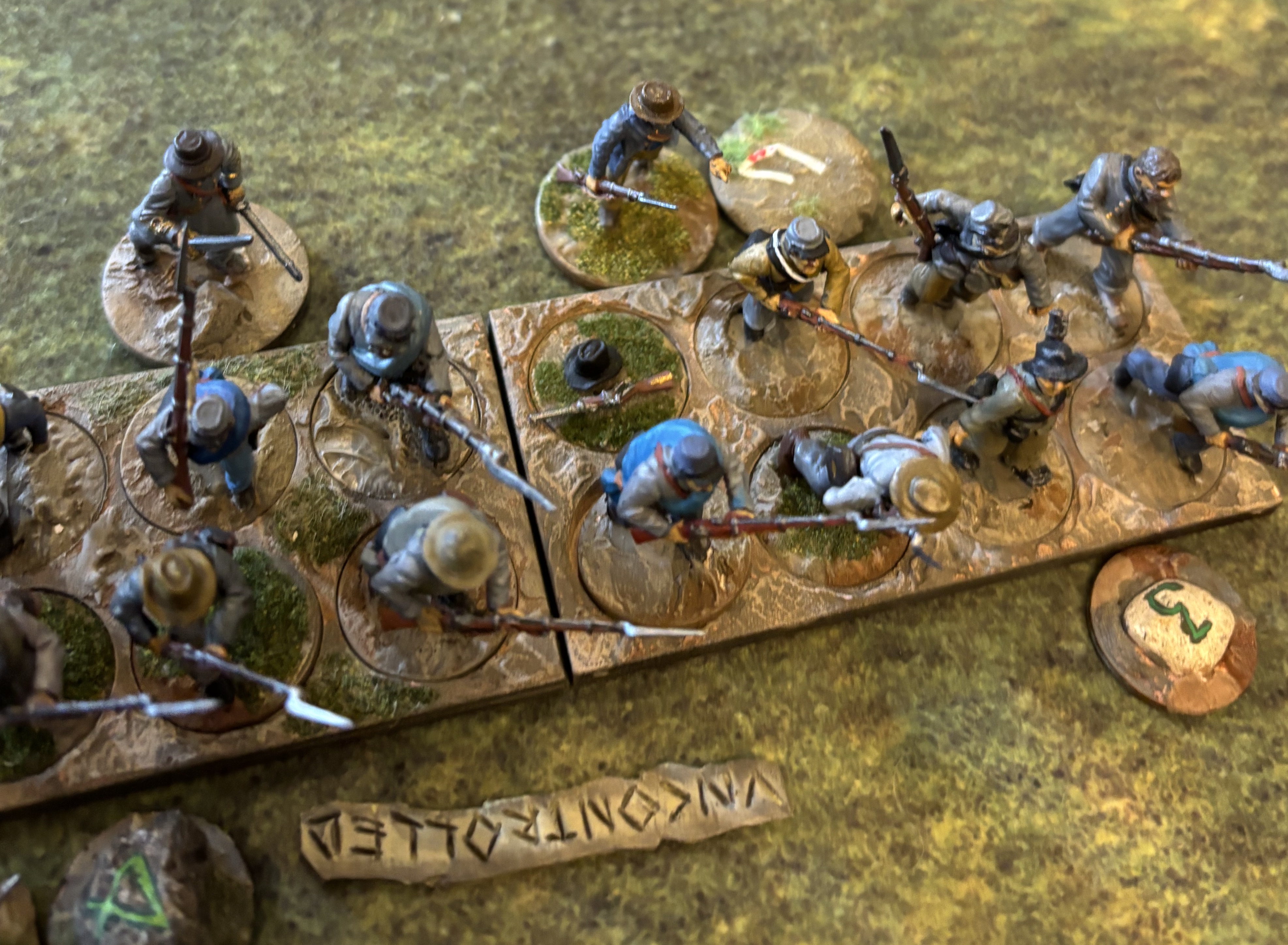
Haulin' our asses from Manassas
![]() |
| The bandage marker indicates the leader's reduced status |
![]() |
| The "fouled barrels" marker doing duty to show "damp powder". |
- Restructuring the game as two Union players versus two Fate players,
- Adding a fourth Union Leader (a sergeant with a special knack for finding stragglers),
- Reducing the card count slightly by adding one of the late-arriving wagons to the initial traffic jam, and
- Creating some more options for the Fate players when it comes to using command flags.
Tuesday, June 10, 2025
A first run from Bull Run
Today I essayed a first, tentative, alpha test of my Steel Lard scenario Running from Bull Run.
It's an exploration of the Union retreat after the first battle of Bull Run in 1861. The emphasis is on the Union players attempting to impose some kind of order on the fleeing troops. An officer who can march back to Washington at the head of a formed body of troops, rather than as just one man among a fleeing multitude, may be destined for greater things in the battles to come!
I didn't lay out the full terrain this time - just enough to get the basic mechanisms tested.
This is quite different to just designing a Sharp Practice scenario. Because I'm dealing with troops who are effectively already routing, I'm pretty much designing a new game. The first contact between what I thought was a pretty good plan and the wargames table has already led to a load of changes!
I wanted to capture the impression of a road crowded with fleeing men and vehicles. I think this worked reasonably well....
At one point a few Confederate pursuers made an appearance. Led by Lt Jessop West, they let fly a volley needing 5s and 6s to hit. Rolling ten dice they could surely expect some success...
![]() |
| ...or perhaps not. |
Friday, June 6, 2025
Painting horses - colour recipes
Richard Phillips pointed me to a Youtube channel, I think it was called something like "Loki's Great Hall", that had an excellent series of tutorials on painting 28mm horses. The creator used Vallejo acrylics and because that's the range I mostly use, it was really useful. Sadly the channel seems to have disappeared.
![]() |
| Russian dragoons - a chestnut nearest the camera, a brown behind it. |
Fortunately, though, I scribbled down some of the recipes. I'm sharing them here in case they're of use to anyone and as a bit of insurance in case I lose the piece of paper.
In each case there are three colours in order from darkest to lightest. The technique is to base coat the horse in the darker colour and them gradually apply layers with the lighter colours applied to increasingly smaller areas that are higher up and/or catch the light more. These layers are applied as follows:
- Layer 1 - first colour
- Layer 2 - 50% first colour + 50% second colour
- Layer 3 - second colour
- Layer 4 - 50% second colour + 50% third colour
- Layer 5 - third colour.
- German Camo Black Brown 822
- Hull Red 985
- Mahogany Brown 846
- Hull Red
- Cavalry Brown 982
- Red Leather 818
- Cavalry Brown 982
- Red Leather 818
- Orange Brown 981
- German Camo Medium Brown 826
- Beige Brown 875
- Cork Brown 843
- Leather Brown 871
- Mahogany Brown 846
- Beige Brown 875
- Splinter Blotches II 347
- Feldgrau Highlight 339
- Light Mud 315
- Dark Sand 847
- Pale Sand 837
- Off White
- Matt Black 950
- Black Red 859 or Black Green 980
- Deck Tan 986
- Silver Grey 883
- White Grey 993
- Rose Brown 803
- Beige Red 804
- Salmon Rose 825
- Dark - Burnt Umber and US Field Drab
- Light - Beige Brown and Brown Sand
Sunday, June 1, 2025
Kamikaze Tank Destruction Teams
The Approach to Mutanchiang scenario called for the use of special suicide teams of anti-tank troops by the Japanese.
Here are the rules I drafted for the purpose.
Any company that has an attached Kamikaze Tank Destruction Team may, once per game, launch a "human bullet" (nikuhaku kÅgeki) attack subject to a successful Tac roll.
The attack must be declared at the start of any Fire Phase during which the parent company is able to fire. The range of the attack is the movement distance of an infantry element in Bold Attack Mode in the appropriate terrain, measured from any element of the parent company. Note that the parent company can be in any Mode that allows firing (PD, D, DT, DA or BA).
It's not necessary to have figures representing the team but feel free to make some! The path from the parent unit to the target platoon should be indicated and the enemy may fire at them, treating them as a soft target, with any unit able to detect them and fire in the current Fire Phase.
The team ignores Neutralised combat results. If they are not destroyed, they attack the targeted unit counting as Assault Engineers (4/1).
After the attack the team is removed from play without any negative impact on the morale of the parent company. However, if the team is destroyed by enemy fire during the attack, a Company Morale Test is triggered (although the team does not count towards percentage losses).
Note that the TacWWII rules already allow for infantry units making attacks against hard targets with "grenades and heroism". No specific range is given in the rules for these attacks. My proposal is that they may be made if the attackers ended the Movement Phase in contact with the target or if the target passed within 1cm of the attacking unit during the Movement Phase. I'd suggest that these attacks may be made in addition to "human bullet" attacks.