Thursday, December 26, 2024

Do you know the way to St Omer?

Late on Christmas Eve, while the rest of the family were glued to Strictly or some such TV entertainment, I decided to try out one of my new battle-mats. 

In my workshop there's an old plan-chest  that provides a small gaming space if I remove the crap usually covering it and if I don't mind getting a sore back whilst playing. The "Grassy" mat folded in two covered it nicely.

I fancied a little TacWWII and went with the smallest scenario from this venerable volume. 

The Road to St Omer sees the British 3rd Battalion the Royal Tank Regiment (3RTR) clash with lead elements of the German 1st Panzer Division just south of Calais in May 1940.

This was one of my contributions to the book and I hadn't played it since play-testing in 2000 but I knew that I had all of the models and could whip up an approximation to the terrain with mostly things I had to hand. I'm quite pleased with how it looked.


Near the centre of the table is a sunken road that I marked with some clump foliage but then I thought, "I could do better than that".

A quick scrabble through the terrain material stores (in the same plan-chest) provided off-cuts of PVC board and foam core. Cut, chamfer, glue, apply quick-drying Polyfilla, paint, PVA, apply mix of flock and static grass and you have a couple of "sunken road markers". Probably took me less than an hour including time for the Polyfilla to set and the paint to dry.


While waiting for the rest of the family to get up on Christmas Morning I made a start on playing the scenario solo. It's an odd one, with armoured companies (in this case a German armoured car company and a British tank squadron) blundering into each other, in column of route, at point-blank range.

It's challenging for the British, in their first action of the war, to shake themselves out into a decent fighting formation against fully worked-up recon troops of 1st Panzer Division who have already fought their way across Belgium and France. I rated 3RTR as Tac 7 whereas the Germans are Tac 5. This means the Brits have a 40% chance of changing Mode while the Germans are on 60%. 

In between domestic duties I managed to get through five of the scheduled eight game turns. The close encounter range made for a bloody opening with one of the German armoured car companies losing three platoons straight away for the loss of one British tank troop.

When researching the scenario I knew it would play oddly in that both sides have mostly (or in the British case entirely) armoured elements but also a number of units with little or no anti-armour capability. This made for some interesting tactical choices.

3RTR's two cruiser tank squadrons clashed with German companies with a mix of armoured car types. The British 2-pounder is superior to the 20mm cannon carried by the SdKfz 222s and 231s but the German companies are larger (six models to three) and so tend to be a little more robust when it comes to morale tests.


As the scenario proceeds, additional German companies arrive, the first being a heavy company with three Panzer IV troops.


As the Brits advanced across the railway line they were met by stiffening German power. By the time of the pic below, 3RTR's A Squadron had driven off their German opposite numbers but been forced to flee themselves. Here we see B Squadron with all three troops neutralised and with C Squadron's Light Tanks Mk VI advancing on their flank.

At this point A Squadron badly failed its test to rally and entirely lost cohesion, the remnants being seen to flee through Cocquelles. This triggered a Battalion Morale Test with resulted in a "Halt" result.

Turn five saw a light tank company (Panzers II and III) arrive on the German left and although their heavy company was forced to retire, this was not before it had wiped to 3RTR's B Squadron. With a second light company arriving on game turn six and the British reduced to two squadrons of light tanks, I decided that Brigadier Nicholson had arrived and ordered the British force to withdraw into the Calais perimeter.

If you've seen the film Darkest Hour, you'll know that the Calais garrison will be sacrificed to delay the German advance on Dunkirk. Most of 3RTR's tanks will end up being pushed into the harbour to prevent their capture by the Germans.

As always I was delighted by the way TacWWII makes for an engaging narrative. I could readily envisage the British CO's frustration in trying to put together a battle line in the face of an aggressive enemy, particularly when a Tac roll revealed that (as happened historically) the HE rounds for his close support tanks' guns had been left behind on Southampton Dock.

More TacWWII must follow in 2025! 


Friday, December 20, 2024

Review of the year 2024

My hobby year 2024 began with a new purchase; Bloody Big Battles.

I've been years searching for a set of rules that allows me to make satisfying use of my 6mm Franco-Prussian War armies and it finally looks like these are the ones for me. Mate Chris Pringle does a great job of concisely and unambiguously laying out his rules and this is no exception. 

I've only completed one solo play through of the Battle of Coulmiers so far...


... but I'm keen to do more. I've started rebasing my Irregular Miniatures strips and organising them to do Froeschwiller some time in the coming year. There's even a plan at the back of my mind to maybe do Waterloo eventually!

January also saw the start of a new campaign. Muddy River Blues is designed as a time-limited, play-by-email exploration of counter-guerilla operations in Mississippi during the American Civil War. The main rules in use are Sharp Practice but I did use a modified version of Arc of Fire to resolve one particularly small encounter between patrols in the overgrown bottom-country west of Badfinger...


Ron and Richard are the players in this one and it's been fascinating to watch their forces moving about the map with very limited intelligence about what's actually going on. I suspect both sides would benefit from getting their player character commanders back to base temporarily to pick up news of events. The campaign rather ground to a halt in the latter half of the year as I was busy with other projects (see later) and Richard was working away from his home. I must get back into the saddle on this one.

Spring saw a few games of The Pikeman's Lament. A few Thirty Years War games in 6mm scale were supplemented by another game in our very irregular series of 15mm Samurai actions set around the Siege of Hachigata. This is another project I need to move to a conclusion.


The first big project of the year was Crisis Point 2024. This event was disrupted by first one and then a second game-runner dropping out due to family commitments or illness. In the end we managed with two games and the event was a great success.

I wanted to run a large game of TacWWII but was determined not to get bogged down with a huge game for all attendees. Having Andy and Neil available to run a parallel game of Cold War Commander and effectively splitting my own game into two semi-independent, four-player games meant that the event was manageable and went off very well.


In June I took Harpers Ferry down to A Barnful of Lard in Bristol. 


The terrain is now in storage so that may be the game's last outing for a while. With six sessions at Lardy Days and three or four playtest sessions it's difficult to argue that the ratio of preparation time to play time is reasonable. However, I enjoyed the process of researching and designing the game and building the terrain so any decent cost-benefit analysis needs to take that into account.

In August I arranged a first game of a Cold War adaptation of TacWWII with Richard and Phil. The Battle of Jijiga was an adaptation of a scenario from Battlezones by Mark Bevis.  It was an Ethiopian clash with Somali rebels and featured a number of T-54s and buildings 3D-printed especially for the occasion.


I was pleased with how the rules worked though it's been pointed out that I was probably generous in giving the defending rebels the opportunity to evade incoming ATGWs. In my defence I was more keen on testing the rules mechanisms than in accurately simulating the command and control limitations of WSLF tank crews!

The second half of my 2024 was dominated by preparations for Steel Lard. Quite apart from the administrative burden of recruiting game-runners and then allocating players to their games, I found myself spending so much time getting my Siege of Puebla game designed and built that very little other gaming took place.

The self-imposed design constraints were such that I needed to build 16 square feet of city and four of French siege works. In addition I'd made up my mind to have buildings progressively replaced by ruined versions as the game continued so I ended up with a major construction effort even recycling some buildings from previous games.


On top of that I needed to design and test new night-fighting rules for Sharp Practice and to create player-character commanders whose personal objectives and psychological peculiarities mitigated the risk of a siege warfare scenario bogging down into a static firefight.

In the end, things worked out well but I did feel that Puebla had perhaps taken up too much of my focus. By the end it was beginning to feel like a bit of a chore to keep working on it. 

It's fair to say that since I got past Steel Lard, my hobby time has been spent on a glorious mish-mash of unconnected painting and historical research. Perhaps the epitome of this was an mostly pointless diversion into 15mm Thirty Years War that can only result in some more figures going on eBay.

Rules-wise the year has been dominated by Sharp Practice with seven games, followed by TacWWII with four and The Pikeman's Lament with three. After that there were occasional outings of Bloody Big Battles, Flight Leader, Hordes of the Things, Arc of Fire, and What A Cowboy. The last of these should make its way into joint third place after I've run a game over the Christmas holiday period.


So that was 2024. I'm not displeased with how any of it went but I'd like to avoid getting so bogged down into all-consuming major projects in the coming year... of which more anon.


Sunday, December 15, 2024

The Streets of Brownsville

One of my games this Christmas is The Brownsville Raid, 1859. In September of that year the Mexican rancher, cattle rustler, patriot, and later army officer Juan Cortina mounted a nocturnal attack across the Rio Grande to kill his sworn enemies in that place.

Here's my representation of a small portion of Brownsville for What A Cowboy:


I don't intend to stick as closely to historic events as I did with the Harpers Ferry game - this is going to be more of a Hollywood version of the raid.

Our story takes place in southern Texas after the end of the Mexican War. In an atmosphere of anti-Mexican racism, white settlers (the terms anglos or gringos are used interchangeably) have been using questionable legal practices and sometimes outright violence to take over the farms of established Mexican families.

Jerry Thompson in his Cortina: Defending the Mexican Name in Texas gives us the background:


Our scenario takes place the following September when Cortina, backed by perhaps 100 "Cortinistas", mounts a nighttime raid determined on revenge for the slights endured by Mexicans on the lower Rio Grande.

The player-controlled citizens of Brownsville will be people on Cortina's list of enemies or, in the case of the jailer Robert Johnson, on the personal revenge-list of some of the Cortinistas. They are:


Adolphus Glaevecke, a German immigrant,
former medical student, rancher, cattle thief,
and distant cousin by marriage of Cortina.

Robert Shears, the town marshal,
not yet fully recovered from the bullet
Cortina put in his shoulder in July.

George Morris, blacksmith and
town constable, perpetrator of 
"many Mexican murders".

Robert L Johnson, the jailer, who lives
 in a house adjoining the city jail.

And on the side of the attackers we have:

Juan Nepomuceno Cortina himself.

Tomás Cabrera, victim of Shears' pistol-whipping
and now Cortina's right-hand man.

Juan Vela, who loves his brother...

... Alejo Vela, who hates Robert Johnson.

In addition there will be groups of anonymous Cortinistas - I'll be trying out the Henchmen rules for the first time.

This will be my second What A Cowboy game based on events in 1859. Harpers Ferry was very much in line with the historical events in the Federal Armory in October. This time I've gone more "Hollywood", changing the locations of some events and the positions of characters to encourage more fast and furious action. I will, however, be adding a few scenario-specific rules to capture some of the events of the night.

Tuesday, December 10, 2024

New battlefields - amended

Steel Lard brought home to me the visual difference between, for example, Ken Welsh's French and Indian Wars set-up:


... and my emergency ACW game:

Now obviously my game was thrown together at the last moment but clearly Ken's printed battlemat makes a huge difference to the visual impact. I decided to splash out.

I've gone with Geek Villain's fleece mats. As Jonathan of Wargaming Recon has pointed out in the past, the texture is lovely; they'd make a very comfortable throw for your bed or sofa!

I decided on two 6'x4' mats, "Grass" and "Rocky Grass". These have the advantage of being the same underlying pattern so I can combine them if I ever need a 12'x6' playing area. Alternatively they'll do nicely for the two-tables-side-by-side approach planned for my Attack on the Northern Hills game.

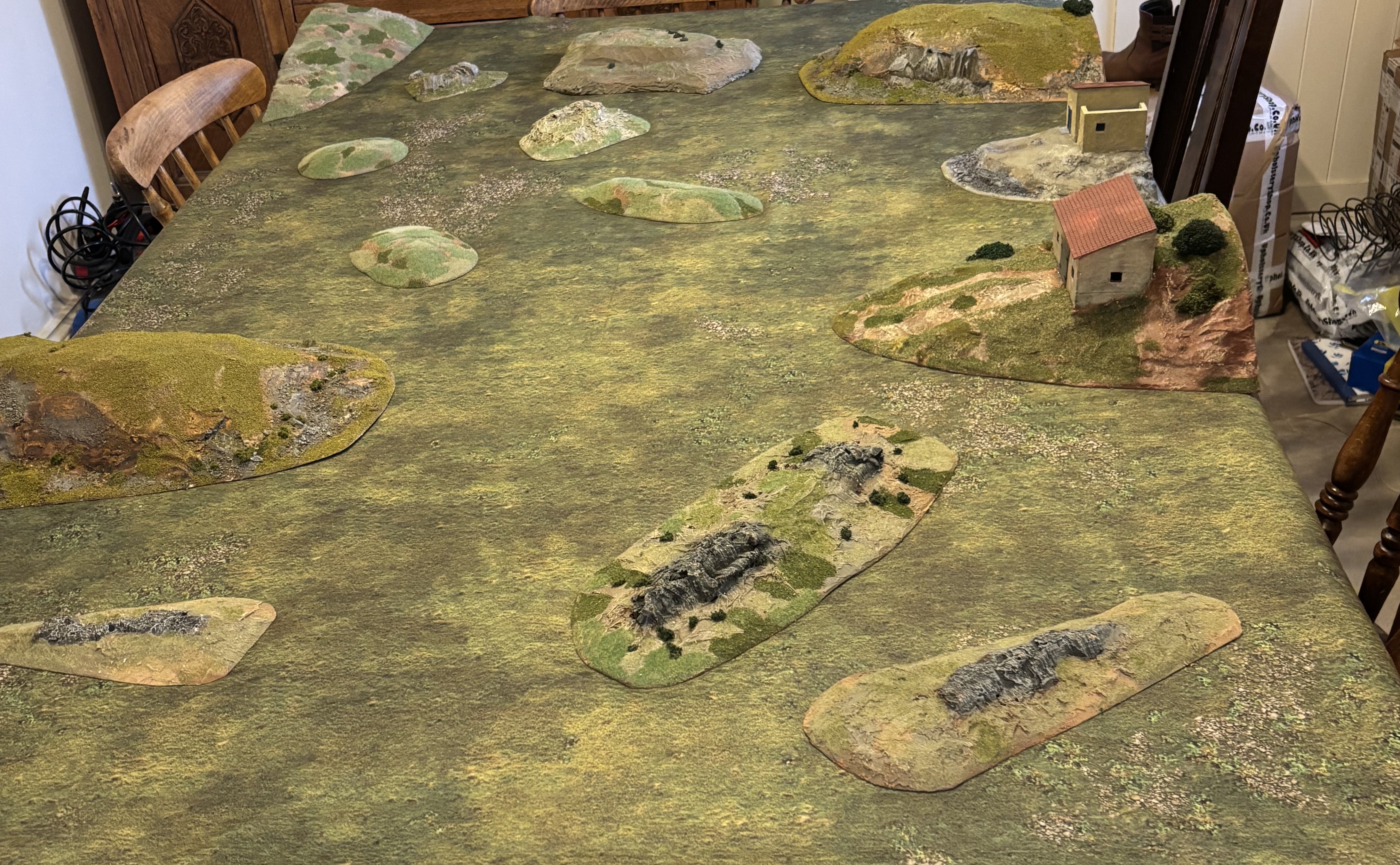
At the moment our kitchen table spends most of the day being used as a workbench for the Baroness' traditional upholstery (an Edwardian sofa won't fit in her workshop) but I did manage to get in a quick photo session with the "Grass" mat.  It shows varied greens with scattered grey rocky areas.

And when I place a few hills on top...

Despite the hill modules having been built, painted and flocked at various times and with various recipes of ground cover, I'm quite pleased with how they blend in.

And here is the "Rocky Grass" mat.


I wanted to see how the mat worked with a hill underneath it. The fort in the pic above is actually on a low rise made from corrugated cardboard and various types of foam. The effect is nice and subtle I think you'll agree.

I'm not entirely sure about the rocky bits when seen close up...


But overall the existing hills blend well into this one too.

I paid £130 for the two battlemats and on the whole I think they represent value for money. I see no reason why they shouldn't last for ages and they potentially free up storage space that's currently being occupied by six 2'x2' chipboard tiles.


Monday, December 9, 2024

Weird artillery

I've recently had a period of building models out of the stash for no other reason than I fancied doing so. It's quite therapeutic to just think, "I don't need this for a game but sod it, I'll just build it".

The latest thing to come out of the stash is a couple of 20mm scale "French" guns that were in Akheton Models blister packs. The inverted commas reflect that fact that while the diminutive crew are in Adrian helmets, the guns themselves aren't a very good match for any particular weapons.


The barrels look like those of the famous 75mm Mle1897 but the carriage has wheels that are way too small.

I might declare them to be an Andreivian modification of the French gun and draft them into one of our post-WW1 games.

Friday, December 6, 2024

Christmas scenario

I'll be running an Andreivia 1918 game this Christmas. Here are some figures that will appear. 


You can learn more on the Andreivian Tales blog here.


Saturday, November 30, 2024

Attack on the Northern Hills

This is the first-draft outline of a scenario for Arc of Fire that I'm working on for possible use at Crisis Point 2025. It's a slightly redacted version to keep a little of the detail from potential players.

Background

Russian forces have previously occupied Tcherbevan International Airport and are pushing to capture the bridges over the Krupnehr River with a view to moving into the centre of the capital.  However, their base at the airport continues to come under fire from Andreivian-Armenian artillery in the Northern Hills. Russian units are ordered to attack into the hills and destroy the artillery.

Situation

The game takes place on two tables representing hilly areas separated by the impassible Shavi Kedi (or Black Ridge).  Travel between the two tables is possible only across the Maghali Pass.

Both tables represent areas that are largely under Andreivian Armenian control. There are two villages on the western table; Khndzori Arahet and Hamardzaktun. They are connected by a road that forms a key Armenian line of communications and that then runs through the Maghali Pass

The eastern table has an old ruined fort (under Armenian control) at the end of Maghali Pass. From the fort another key road leads down to an Armenian village, Menak. In the east is the village of Melas Gora under Andreivian Government control. A road running northeast from this village is a key Government supply route.

Areas shown as plain green on the map above will be broken up by as many steep hills as we can squeeze on - this isn’t countryside that’s going to be dominated by one or two tanks! Steep hills are impassable to vehicles and cannot be used to deploy artillery. 

Deployment
Andreivian-Armenian forces can deploy anywhere on the map (at least X” from the southern edge and Y” from Melas Gora). One artillery piece must be deployed in the central third of each table. The artillery pieces do not need line of sight to the airport - they are firing based on from reports from spotters and intelligence received from Armenian agents in the city (we know this from a previous matrix game).

Andreivian Government forces deploy within Melas Gora

Russian forces enter from the southern edge. They can split as they like between the two tables but note that they need to take out both guns. Optional Russian helicopter deployment if enemy leave rear areas unguarded?

Victory Conditions 
Each faction has a victory target of five points.

The Russians gain victory points as follows:

Action

Victory Points

Destroy both Armenian artillery pieces

3

Each village captured

1

Controlling the line of communications between two uncaptured villages

0.5

<redacted>

2

Note that no VP are awarded for destroying only one of the artillery pieces.


The Armenians gain victory points as follows:

Action

Victory Points

Every X artillery rounds fired at the airport

1

Each village/fort* held at the end of the game

1

Cutting the Government’s line of communications to Melas Gora

1

Note * <redacted>.
Note that an Armenian village or the fort gains only 0.5 VP if the line of communications is cut on one or both sides of it.


The Andreivian Government gains victory points as follows:

Action

Victory Points

Melas Gora is held

3

<redacted>

1

<redacted>

1

Menak or the fort brought under Government control

1


Forces
All forces are to be agreed based on what we have/what people want to play with. But see the following…


Andreivian-Armenian Forces
A selection of militia infantry and assorted vehicles.  
Must contain two artillery pieces. 
Must have <redacted>.

(I have one M1938 122mm howitzer)


Andreivian Government Forces
Platoon of Government paratroops and assorted vehicles

Russian Forces
Mostly infantry but may have a couple of tanks. Perhaps two reinforced infantry platoons?

If people are happy to learn the artillery rules (they are fun) the Russians and potentially others could have limited off-table fire support.

(I have a platoon of VDV airborne troops and am working on a similar force of Naval Infantry.)
(I have two T-80s)


Aircraft can be unbalancing in skirmish games but I have a few suitable aircraft models (Andreivian Government A-4 and Mil-24, Armenian Hawker Hunter, and Russian MiG-27) that it’d be fun to use. Perhaps appearing as a result of rolls on a tweaked version of the Random Events Table?