Sunday, August 3, 2025

Another TacWWII marker

I had a play around on Tinkercad yesterday and designed a new marker for TacWWII:

Sized at 75mm x 40mm, these company markers can potentially fill two functions.

Having spent ages advancing infantry companies through the dense forests of Manchuria in a recent game, I thought it would be useful to just have one base to move, specifically when the troops concerned were nowhere near the enemy.

In addition they could act as blinds allowing for limited intelligence as to enemy strength. Each marker carries an identifying letter on the rear.


These letters can be used to identify particular companies on the order of battle sheet. The opposing player will be kept in the dark as to unit type until the company can be detected (though speed of movement may give some clues!)


Friday, August 1, 2025

A Vintage Classic

My mate Mark P bought me a couple of Airfix kits as Christmas presents. This one has just reached completion:


It's the Tank Mk 1 from the Vintage Classics range. It's a 1967 moulding so nearly as old as I am!


The kit comes with a single decal and a painting guide for a vehicle at Fleurs-Courcelette during the Battle of the Somme in September 1916. However, I decided I'd paint mine in an overall grey scheme representing a vehicle prepared for testing at the Lincoln factory earlier in the year.


It's generally not too difficult a kit to build. A little filling and sanding was necessary to hide some of the joins between the armour plates. The biggest problem is attaching the steering trailer to the complex mechanism of springs at the rear of the hull. I think a permanent display base is going to be needed to prevent future breakage.


Monday, July 28, 2025

First Gangs of Rome models

Three weeks ago I took delivery of a box of Wargames Atlantic plastic Citizens of Rome. Having spent a fair chunk of the intervening time gluing and painting I'm now very nearly in a position to get started with the rules. In fact I've painted 19 figures; very nearly one a day.

As I reported previously, the box gives you enough parts to make 30 miniatures with the emphasis on gang members in combat poses.

However I did manage to produce a few figures that will pass for less violence-focussed civilians:


The 80mm sabot base identifies these miniatures as composing a "mob" into which fighters may disappear if things get too hot.


The ducks are some white metal castings that were sitting in my spares box awaiting a useful purpose. the racks of amphorae are 3D prints from Thingiverse.

Another mob base is this shepherd and his flock, obviously more relevant to rural games or to muckier parts of the city.


At the moment I don't really have any Rome-specific terrain so this photoshoot features my Warbases villa standing in as a large town house.


A mixture of homemade and Hovels resin-cast walls provide privacy to the senatorial family who live here. It seems they aren't at home as a number of ne'er-do-wells have penetrated the garden.


Fortunately the Vigiles Urbani are on the way:


I've found scribed Milliput to be the best way of making paved bases. Here we see a couple of vigiles bases, before and after painting. Each base gets a coat of Vallejo Basalt Grey before the individual stones are picked out with Pale Grey.


Thursday, July 17, 2025

A Chilean Vampire

I bought the Airfix de Havilland Vampire kit when it was available cheap from Lidl (or was it Aldi?) before Christmas. Unfortunately, though, it comes with only one set of markings; for a Royal New Zealand Air Force aircraft. I'd already built that one so I invested in a set of after-market transfers from Xtradecal, paying significantly more than I did for the kit itself!

I've just finished the model. It represents a Vampire T.11 of Grupo 8, Chilean Air Force at Cerro Moreno airbase, Antofagasta in 1973-74.


I wasn't 100% impressed with the decals. The "NO PASO" (do not walk) markings on the wings are printed with the decal film only covering the lines themselves, not the whole of the area. As such, as soon as they came off the backing paper they collapsed into a ball of red lines that I couldn't untangle. In the end I used the markings from the kit for the trailing edge markings.


It's far from the best model I've made but the colour scheme's unusual and I quite like seeing it in the display cabinet alongside the RNZAF version. 

If I see another copy of the kit I'll grab it. There's a pre-UDI Rhodesian aircraft that's calling to me. It looks very British apart from the African spears on the wing roundels!


Wednesday, July 16, 2025

Joy of Six report

So Joy of Six is behind us for another year and I have to say I enjoyed it despite Sheffield Hallam University being on sauna setting for the day.

The Cold War Commanders Operation Vijay game was a success, I think, with Andy T and Neil M actually running/playing the game and me chatting to punters. Considering that the detailed scenario and the table set up were pretty much improvised on the day, it all worked out very nicely.

I think the Geek Villain mat worked well


An Indian Canberra flies over the victorious
Indian infantry

Other games included a marvellous Nomad assault on Pavis using the Midgard rules put on by author James Morris and pals:


Great fun to see a 6mm, massed-battle version of an action I've gamed in 28mm at skirmish level.

The MaDGamers of Maidenhead and District did a recreation of Alam Halfa, 1942 using the Rapid Fire Reloaded rules. Interestingly their handout says that they used both Baccus 6mm and Heroics & Ros miniatures in the same game. I can only assume this refers to men rather than vehicles as otherwise the scale differences would have been too noticeable.


Again the printed cloth worked well and the game certainly gave the impression of mostly empty desert.

Adjacent to our table were the Ilkley Irregulars, who put on Waterloo using Bloody Big Battles, something that I myself would like to do one day. In fact I bought a copy of the scenario book from them!


It wasn't the prettiest game at the event but the participants were clearly having a great time. I believe Napoleon was successful this time.

Given the very zoomed-out scale it's not so easy to produce lovely-looking terrain for a Bloody Big Battles game but the COGS group from Chesterfield achieved it with their Mons 1914 set up.


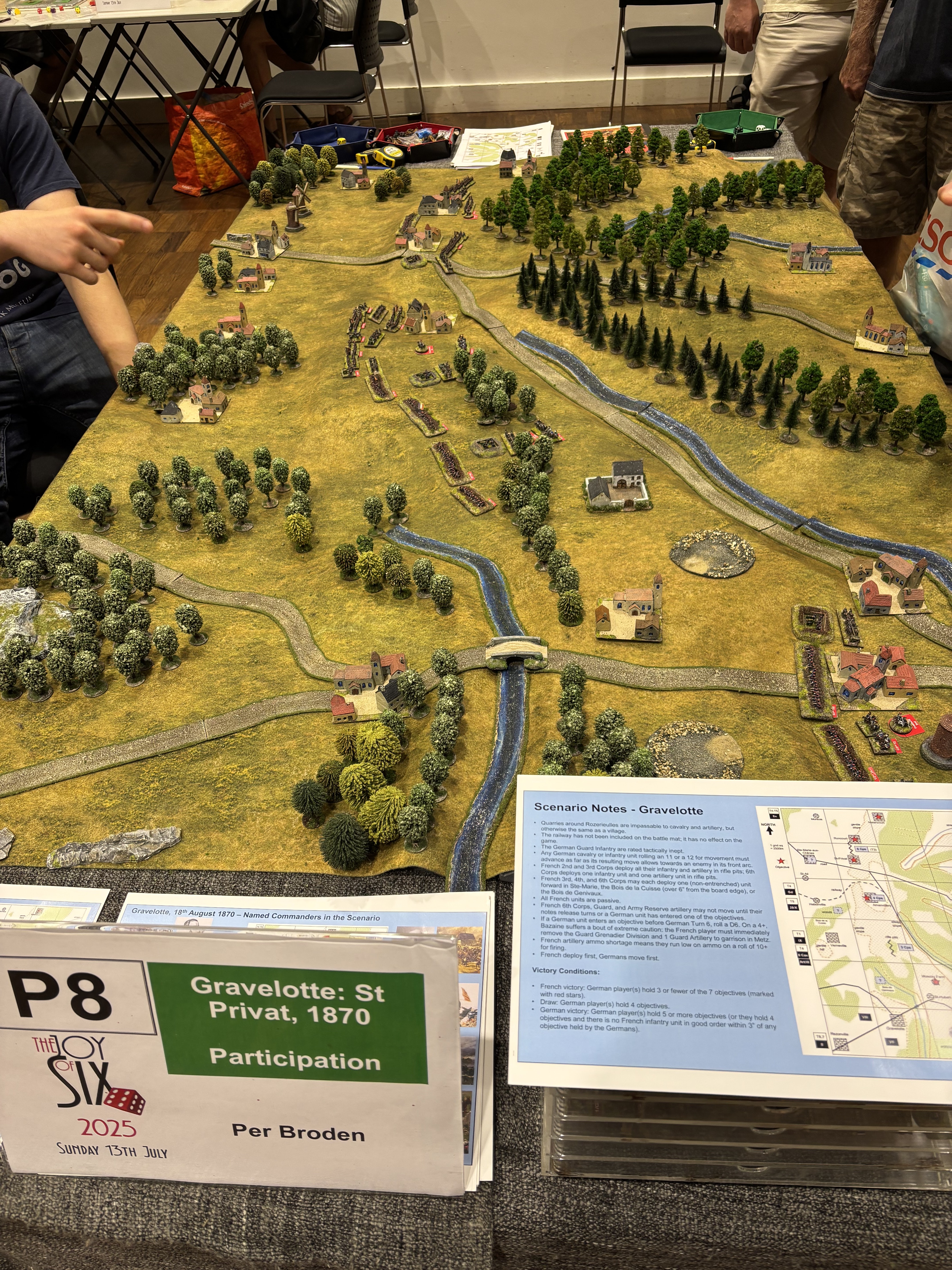
And finally among the Bloody Big Battles offerings was Per Broden's Gravelotte/St Privat, 1870.


This was lovely despite ParcelForce losing Per's dedicated game mat and his having to rebuild the battlefield using a borrowed one! 

Another very attractive game was the Siege of Bastogne by James Mitchell and Brendan Dolan. 


It's far from obvious but the table is actually organised on a square grid to support the rules in use, Eisenhower by Sam Mustafa. Very subtly done!


Total Battle Miniatures put on a small but beautifully formed representation of the 18th century Battle of Lobositz.


I thought the river was particularly nicely done.


Two American Civil War battles were represented. At the smaller scale was the Poe's Field portion of the battle of Chickamauga put on by the Three Shires group.


While the Leeds Wargames Club used Pickett's Charge to portray the Champions Hill battle during the Vicksburg campaign.


There were many other games but I didn't manage a comprehensive photo shoot this time I'm afraid.

I greatly enjoyed the day. Peter Berry tells me numbers were down this year but given that it was one of the hottest days of the year, I'm sure many who might have attended on a whim decided there were better ways to spend their time. Certainly for me a refreshing pint at the nearby Rutland Arms was much needed at the end o the day!

Thursday, July 10, 2025

A much delayed debut

As I've reported previously, it's the Joy of Six show this weekend and the Cold War Commanders group are putting on a game. Operation Vijay (or Sample Appreciations of Tactics, the Wargame), represents a slightly fictionalised version of the Indian seizure of Portuguese Goa in the early 1960s.

The game will offer a chance for what I believe is the first serious deployment of some of the oldest models in my collection:

Portuguese EBR armoured cars

At some point in the late 1970s I acquired this book:


Up to then, the only set of wargames rules I'd managed to understand well enough to play with was the same author's Airfix Guide to WW2 Wargaming

Keen to try another set of rules I determined to spend some of my limited pocket money on some white metal micro-tanks from Games of Liverpool. Unfortunately, my knowledge of French-manufactured armoured cars was limited and I accidentally purchased EBRs instead of AMLs.

As such, the EBRs never got used other than in a couple of practice sessions to learn the rules. They were based for Cold War Commander and repainted in olive green about two decades ago but Sunday will see them used in a "proper game" for the first time ever. Just goes to show; you never know when your time to shine will arrive!


Tuesday, July 8, 2025

The what now?

The Russo-Turkish War of 1711 was a short-lived, obscure sideshow of the Great Northern War. The Kuban Campaign was a short-lived, even-more-obscure sideshow of the Russo-Turkish War of 1711. As such, it's ideal for those of us with penchant for lesser-known historical settings.

I've been wanting to make more use of my 6mm Great Northern War miniatures for some time so in the hope of inspiring myself, I pulled off the shelf Nick Dorrell's Peter the Great Humbled, The Russo-Ottoman War of 1711.

The problem is that I'm not presently motivated to relearn Shot, Steel and Stone or to learn Twilight of the Sun King, the two sets of rules in my library that are most obviously relevant. I decided therefore to see if I could use my 6mm chaps to fight an action from the period with The Pikeman's Lament.

I set up a scenario based on a Russian column advancing towards a small Tatar settlement. A single road (little more that a muddy track) crossed the table and there were scattered woods and areas of broken ground.

The Russians would have three contingents; a Dragoon company supported by a field gun, and two sotnyas of Cossacks. 

The defending Tatars would have two companies of cavalry with a single unit of militia holding the village and counting as a company on its own.

The field of battle seen from the Tatar side

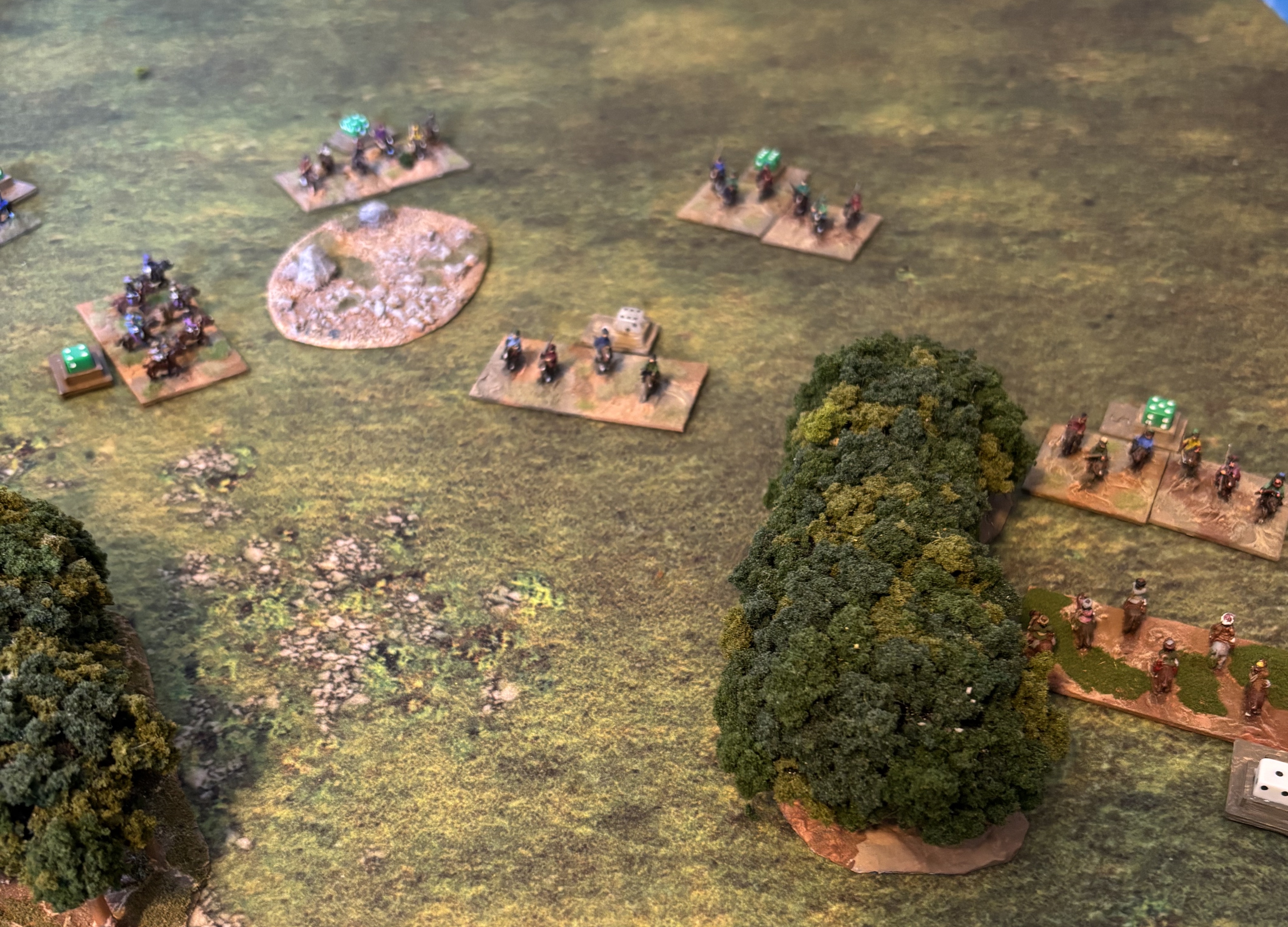
I used colour coded mini-dice to distinguish between the various types of unit on the table. In the picture below we see, from left to right, a white die indicating one of the more experienced groups of Tatar warriors (classed as Veteran Dragoons), a blue die showing that the militia (Raw Shot) were at full strength (they would switch to a yellow die when at half-strength) and a green die showing another, less-experienced Tatar unit (classed as Dragoons). The numbers shown on the dice would be reduced as casualties were taken. In addition, silver mini-dice indicated contingent commanders. 


I was treating this as a solo test of a future Saturday Afternoon Wargame. Worth doing as it soon became clear that I'd started out the two forces too far apart. Quite apart from a delay in getting into action, the non-mobile Russian field gun would never be in range of a decent target throughout the game!

Tulpar's contingent of Tatars prepares to move forward

I did roll up characteristics for the named contingent commanders but they didn't play a major role in the game. The only significant impact came when the recklessly brave Sotnyk Horobet's company were led into a Wild Charge that decimated their already-weakened numbers.

The Russians advanced with their regular dragoons in the centre and a Cossack sotnya on each flank.

Tatars (centre) surrounded by already-weakened
Cossacks including the wavering Horobet

The action on the Tatar left looked like it was going the way of the opposing Cossacks until Captain Horobet's unit was routed. The resulting morale tests saw the rest of the company routed off the table.


In the centre it looked like the Russian dragoons of Captain Likhanov's company would capture the village but the Tatar militia proved a tough nut to crack. They drove off Likhanov and his immediate followers who were then hit from the flank by Tatars previously victorious on the left.

This led to a rout which triggered tests for the rest of the company. Again the Russian dice were unkind and the dragoons left the field en masse.

Despite this, it looked like Sotnyk Nepyipyvo’s still-fresh Cossacks, sweeping around the Tatar right could still save the day.


The Cossacks would need to hit the settlement in repeated waves to take out the militia but I'd decided at the start that the end of the scenario would be determined at the end of any turn where a D6 roll exceeded the remaining units on either side.

With victory in sight the Cossacks were recalled by higher command as the D6 roll finally ended the game. On this occasion a victory for the Tatars as the village was still in their hands.