I've finished the wagon laager from my 6mm scale Gothic army.
The first element to be completed was this small square of camp designed to fit within a To The Strongest! square and still leave room to deploy some light infantry to defend the camp.
Next up we see the whole camp set up to cover three TTS! boxes.
And finally the alternative two-box set up.
The wagons are a mix of converted Irregular Miniatures Hussite war wagons, Baccus Tumbrils and scratch builds. The tents are all home made from plastic rod and Green Stuff.
Monday, July 13, 2015
Sunday, July 5, 2015
Enough is Enough
The remnants of a pack of Baccus Late Roman lanciarii were looking at me funny. "Use us" they were saying, but I didn't really need more light infantry.
Now, I know they work quite adequately as close order Auxilia but I didn't have enough for a whole unit as I've previously based them.
The solution I came up with was to add a little diorama element in the form of a muleteer quickly taking the unit's supplies to the rear:
All of the figures are from Baccus. The muleteer is from the Tumbrils pack. The mules themselves are converted from Napoleonic artillery limber horses kindly donated by Geoff Taylor. The Batavi Seniores, for such they are, are reinforced by a couple of converted figures from the Viking- and Saxon Personalities packs. The passing horseman is a new "hero" to reinforce my equites alares.
Also completed recently is an additional general element for use with pretty much any Germanic barbarian army.
He's from the Viking Personalities pack and is accompanied by a couple of wolfskin-clad ulfhednar. Now the latter are obviously Viking but I've recently been reading Bernard Cornwell's The Winter King and I'm inspired to use these guys with non-Norse armies too. Who's to say that similar ritual practices didn't occur in other Dark Ages cultures?
Finally, I've completed another pancerny unit for my early 18th century Polish-Lithuanian army. Only two more to do and then I can start on the Swedes!
Now, I know they work quite adequately as close order Auxilia but I didn't have enough for a whole unit as I've previously based them.
The solution I came up with was to add a little diorama element in the form of a muleteer quickly taking the unit's supplies to the rear:
All of the figures are from Baccus. The muleteer is from the Tumbrils pack. The mules themselves are converted from Napoleonic artillery limber horses kindly donated by Geoff Taylor. The Batavi Seniores, for such they are, are reinforced by a couple of converted figures from the Viking- and Saxon Personalities packs. The passing horseman is a new "hero" to reinforce my equites alares.
Also completed recently is an additional general element for use with pretty much any Germanic barbarian army.
He's from the Viking Personalities pack and is accompanied by a couple of wolfskin-clad ulfhednar. Now the latter are obviously Viking but I've recently been reading Bernard Cornwell's The Winter King and I'm inspired to use these guys with non-Norse armies too. Who's to say that similar ritual practices didn't occur in other Dark Ages cultures?
Finally, I've completed another pancerny unit for my early 18th century Polish-Lithuanian army. Only two more to do and then I can start on the Swedes!
Monday, June 29, 2015
Mostly Reading
There's not been much to report on here in recent weeks. The garden got rather out of hand while my Mum was in hospital as I was going over to Merseyside most weekends. Now the full flush of Summer has arrived there's been a jungle to clear. So wargames production has been limited - parts for my 6mm scale Gothic encampment and another Polish pancerny regiment (again 6mm).
What I have had time for is reading. Scattered around the place are:
- Oman, The Art of War in the Middle Ages (vol. 1)
- WRG, Armies and Enemies of Imperial Rome
- Gibbon, The Decline and Fall of the Roman Empire
- Webster, The Imperial Roman Army, and
- Bona, The Dawn of the Dark Ages: The Gepids and Lombards in the Carpathian Basin.
From which you can see that I'm on an ancients trip under the influence of To The Strongest! My current dilemma is where to concentrate my efforts. The fourth and fifth centuries are interesting with barbarians ravaging their way across a crumbling Empire. I quite fancy the Gothic war of the 370s. But then there's the middle of the third century. For twenty years from 249 there's a succession of army-proclaimed Emperors and almost constant fighting between claimants to the purple.
226 Persians overthrow Parthians. Franks, Alamanni, Goths begin to appear along the Rhine and Danube. (Oman)
236 “Onslaught of the Quadi Carpi and Goths on the middle and lower Danube” beaten back by Maximinius I and Philip. (Oman)
249 Decius overthrows Philip - civil war in Empire. Goths cross the Danube and Balkans, overrun Moesia and Thrace, scattering Imperial troops before them.
251 Goths defeat Decius (and son) art Forum Trebonii / Arbutus (Razgrad, Bulgaria). First Roman Emperor to be killed in battle with barbarians.
Goths range almost unresisted over the middle provinces of the empire for 20 years. Raid as far as Athens and Dyrrachium (Durres, Albania). Other Goth armies cross the Hellespont and sack Chalcedon, Alexandria Troas, and Ephesus (western Turkey) and Trebizond (Black Sea coast).
258 Sapor’s Persians overrun Mesopotamia and capture Valerian.
269 Battle of Naissus (Niš, Serbia), Galienus(?) defeats the Goths.
After 268 Claudius, Aurelian and Probus reconquer the west from rebel Caesars, clear the Germans out of the Balkan peninsula, win back the east from the Persians and Palmyrenes.
271 After defeating another Gothic invasion, Aurelian abandons Dacia north of the Danube to rationalise the borders of the empire.
297 Diocletian reconquers Britain.
357 Julian defeats south German tribes near Strasbourg.
376 In the summer and fall of 376, tens of thousands of displaced Goths and other tribes arrived on the Danube River, on the border of the Roman Empire, requesting asylum from the Huns. Fritigern, a leader of the Thervingi, appealed to the Roman emperor Valens to be allowed to settle with his people on the south bank of the Danube, where they hoped to find refuge from the Huns, who lacked the ability to cross the wide river in force. Valens permitted this, and even helped the Goths cross the river, probably at the fortress of Durostorum (modern Silistra), Bulgaria.
Valens promised the Goths farming land, grain rations, and protection under the Roman armies as foederati. His major reasons for quickly accepting the Goths into Roman territory were to increase the size of his army, and to gain a new tax base to increase his treasury. The selection of Goths that were allowed to cross the Danube was unforgiving: the weak, old, and sickly were left on the far bank to fend for themselves against the Huns. The ones that crossed were supposed to have their weapons confiscated; however, the Romans in charge accepted bribes to allow the Goths to retain their weapons. (Wikipedia)
378 Battle of Adrianople, Valens and 40,000 Romans killed in battle (near Edirne, Turkey/Bulgaria border).
379 Goths move into and plunder Dacia (western Romania).
380 Goths divide. Tervingi under Fritigern move into Macedonia. The Greuthungi move into Pannonia where they are defeated by Gratian.
381 Western Roman forces drive goths back into Thrace.
382 Peace agreed.
Tuesday, June 23, 2015
More Micro Ancients
With Sharp Practice out of the way I've gone back to completing my armies for To The Strongest! I plan to have Late Roman and Goth armies.
The selection of Baccus minis at Wargames Emporium is pretty thin at the moment but I managed to find a pack of Saxon archers. They are intended for the eleventh century (1066 and all that) but they'll do for pretty much any Dark Age skirmishers with bows.
I've also made a camp base that will sit inside my forthcoming Gothic wagon laager.
The selection of Baccus minis at Wargames Emporium is pretty thin at the moment but I managed to find a pack of Saxon archers. They are intended for the eleventh century (1066 and all that) but they'll do for pretty much any Dark Age skirmishers with bows.
I've also made a camp base that will sit inside my forthcoming Gothic wagon laager.
Sunday, June 21, 2015
The Action at Quatre Jambes
It's with some heaviness of heart that I come to write an account of last weekend's Waterloo Campaign game of Sharp Practice; not because the rules or scenario didn't work but because I, as one of the Allied commanders managed to get comprehensively beaten!
This was our biggest ever game of Sharp Practice and the first time Jamie has designed a scenario and seen it through to being played by a bunch of our friends.
For this game, our kitchen table was extended out to its full 8'x4' extent and decided by a river into two sectors. To the west (nearest the camera in the shot below), Carl's Frenchies lined up against my Allied infantry (two groups of British and two of Nassauers) in what was expected to be a straight attack vs defence game. This was sort of Quatre Bras in micro-cosm, hence the title of this post.
Beyond the river was a small Belgian village where an improbable gathering of heroes were to search for the missing British agent Stephen Maturin.
Leading the search for the French was Brigadier Etienne Gerard (Andy Sangar). Also for the French was Admiral Lord Hornblower (Jamie Crawley), blackmailed by French threats to execute the captive Lady Hornblower.
One the other side of the table Lt Col Richard Sharp (Gus Woodward) and Matthew Hervey (Ron Pierce) led the search for the British.
The cards were reasonably kind to the British in the earl stages if the game and I managed to form a line formation to defend the cross-roads. I had only infantry but felt that I could form square if any enemy cavalry turned up. Initially, though, I had only French Infantry opposing me.
Meanwhile, Sharpe, leading some riflemen, moved towards the village church.
Meanwhile, Brigadier Gerard led a patrol of his Hussards de Conflans towards the village, supported by some grenadiers.
At this point a French 'blind' that had been moving past the crossroads suddenly proved to be a unit of Dragoons! No problem, I thought, I should have plenty of time to form square....
Unfortunately I didn't. Although the British infantry were able to see off the the French assault (albeit with serious casualties), the Nassauer commander's card never came up again through the rest of the game. A quick charge by the dragoons utterly annihilated the Germans and left the French firmly in control of the cross-roads.
Gerard, in typical Gerardian fashion, abandoned his mission of finding Maturin on seeing the opportunity to pursue the defeated allied troops. His hussars clattered over the bridge.
The left Sharpe free to find Maturin hiding in the church and make off with him to the safety of the Duchess of Richmond's ball.
This game confirmed my opinion of Sharp Practice. It's a set of rules that gives a reasonably enjoyable game but the impact of the card driven mechanics with the Tiffin card ending the game turn unexpectedly can throw off the balance of a scenario however carefully the umpire may have planned it.
In retrospect it seemed a little unfair that charging cavalry get to move on the Tiffin card but infantry facing them can't even attempt to form square in response, perhaps for several turns if the cards have been cruel.
I suspect any game of Sharp Practice will bring up a number of situations where the rules are either silent or saying something that on the face of it seems inappropriate. My view is that they really need an umpire to take an unbiassed view on such cases.
This was our biggest ever game of Sharp Practice and the first time Jamie has designed a scenario and seen it through to being played by a bunch of our friends.
For this game, our kitchen table was extended out to its full 8'x4' extent and decided by a river into two sectors. To the west (nearest the camera in the shot below), Carl's Frenchies lined up against my Allied infantry (two groups of British and two of Nassauers) in what was expected to be a straight attack vs defence game. This was sort of Quatre Bras in micro-cosm, hence the title of this post.
Beyond the river was a small Belgian village where an improbable gathering of heroes were to search for the missing British agent Stephen Maturin.
Leading the search for the French was Brigadier Etienne Gerard (Andy Sangar). Also for the French was Admiral Lord Hornblower (Jamie Crawley), blackmailed by French threats to execute the captive Lady Hornblower.
One the other side of the table Lt Col Richard Sharp (Gus Woodward) and Matthew Hervey (Ron Pierce) led the search for the British.
The cards were reasonably kind to the British in the earl stages if the game and I managed to form a line formation to defend the cross-roads. I had only infantry but felt that I could form square if any enemy cavalry turned up. Initially, though, I had only French Infantry opposing me.
Meanwhile, Sharpe, leading some riflemen, moved towards the village church.
At this point a French 'blind' that had been moving past the crossroads suddenly proved to be a unit of Dragoons! No problem, I thought, I should have plenty of time to form square....
Unfortunately I didn't. Although the British infantry were able to see off the the French assault (albeit with serious casualties), the Nassauer commander's card never came up again through the rest of the game. A quick charge by the dragoons utterly annihilated the Germans and left the French firmly in control of the cross-roads.
Gerard, in typical Gerardian fashion, abandoned his mission of finding Maturin on seeing the opportunity to pursue the defeated allied troops. His hussars clattered over the bridge.
The left Sharpe free to find Maturin hiding in the church and make off with him to the safety of the Duchess of Richmond's ball.
This game confirmed my opinion of Sharp Practice. It's a set of rules that gives a reasonably enjoyable game but the impact of the card driven mechanics with the Tiffin card ending the game turn unexpectedly can throw off the balance of a scenario however carefully the umpire may have planned it.
In retrospect it seemed a little unfair that charging cavalry get to move on the Tiffin card but infantry facing them can't even attempt to form square in response, perhaps for several turns if the cards have been cruel.
I suspect any game of Sharp Practice will bring up a number of situations where the rules are either silent or saying something that on the face of it seems inappropriate. My view is that they really need an umpire to take an unbiassed view on such cases.
Saturday, June 13, 2015
Napoleonic Characters part two
The final (probably) addition for tomorrow's game is this mounted officer.
A veteran of the 95th Rifles, he now serves as a Lieutenant Colonel of the Dutch army on the staff of the Prince of Orange. Despite this he retains his threadbare rifles jacket and the cavalry overalls he took from a dead Frenchman in Spain.
His battered hat bears a cockade in Belgian national colours and he rides a captured French horse.
A veteran of the 95th Rifles, he now serves as a Lieutenant Colonel of the Dutch army on the staff of the Prince of Orange. Despite this he retains his threadbare rifles jacket and the cavalry overalls he took from a dead Frenchman in Spain.
His battered hat bears a cockade in Belgian national colours and he rides a captured French horse.
Thursday, June 11, 2015
Napoleonic Characters
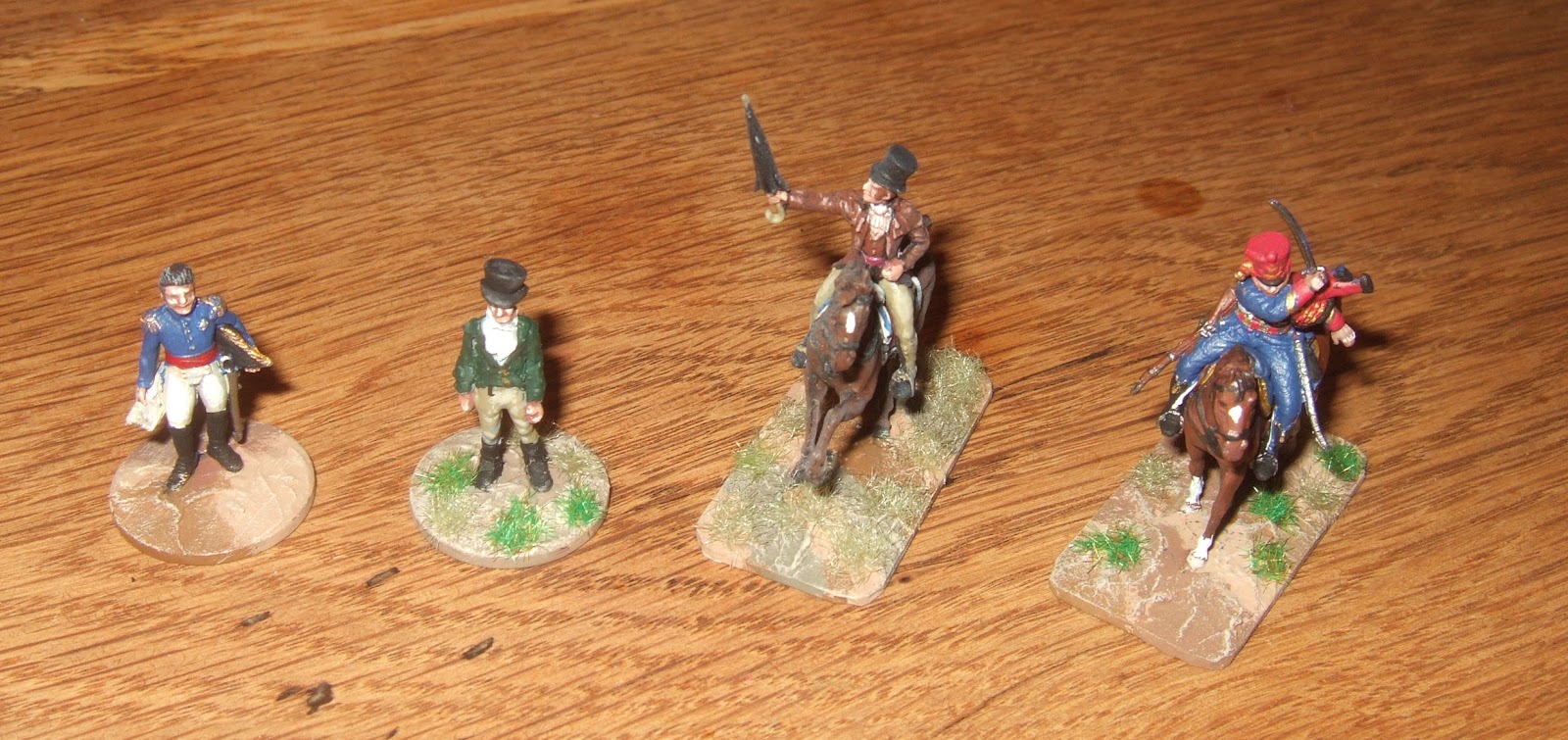
Jamie and I are putting on a Hundred Days-themed game of Sharp Practice on Sunday and I needed some personality figures. I raided the boxes of as yet unpainted figures in storage and came up with these four after a little, very hasty, painting:
These guys were painted for speed rather than accuracy. They'll do the job. A certain veteran Rifles officer is yet to be completed.
From the left we have a British Admiral, last reported in the south of France with his wife, Lady Barbara, but somehow now transported to Belgium. Then we have a well-known physician who has served as a ship's surgeon in the Royal Navy to take advantage of the opportunities to see the world's wildlife and to pursue his secret calling as a British agent. Then there's his friend, a great bear of a man and Royal Navy master and commander. Finally, there's a senior French hussar officer, secure in the knowledge that he is the greatest horseman, swordsman and lover of his generation.
The admiral is a figure from the Italeri Napoleon's Marshals set. The surgeon is a converted HaT Spanish guerrilla. The captain is Henry Picton from the Waterloo 1815 Mounted Line Officers box. The Hussar is an Italeri French hussar on a horse I found in the spares box.
These guys were painted for speed rather than accuracy. They'll do the job. A certain veteran Rifles officer is yet to be completed.
Subscribe to:
Posts (Atom)