Saturday, October 31, 2020

Woebetides - the Spongebob Ship

Some years ago I picked up a bright blue plastic Spongebob Squarepants pirate ship from the local flea market.

Here's what it was originally supposed to look like (mine was missing some parts):


And here's one part-way through the process of turning it to something useful.


I've tried to convert it into an unarmed two-masted merchantman that could be used for the early eighteenth century Woebetides campaign. I've now reached the point where I'm considering it done.  


I've added the decks with coffee-stirrers, including the plastic card quarterdeck you can see under construction in the top picture. The masts and boom are from two paintbrush handles and a chopstick!


I've added anchors and a ship's wheel from Games of War. The hold cover is from cartridge paper over a piece of foamcore. 


Finally, the ladders up to the quarterdeck are from an Airfix RAF control tower kit!

I've kept the rigging both absolute minimum. Enough to keep the masts secure without making it difficult to move figures around on the decks.  

The ship (and others like it) will serve as scenery and possibly as a Deployment Point in next year's Crisis Point Woebetides game.

Wednesday, October 28, 2020

Adapting Bob Mackenzie’s Scenarios to TacWWII

These notes are largely for my own purposes. I don’t think there are very many people using TacWWII these days, which is a shame as they’re a nice set of rules.

Table Size

Bob’s scenarios assume 50 metre per inch scale. To convert to Tac’s 40m per centimetre, simply halve the linear dimensions. Thus a 12’ by 6’ table becomes 6’ by 3’.

Orders of Battle

Obviously the terminology between the rules is different - an “infantry stand” will usually become a “Rifle platoon” in TacWWII. A “command stand” becomes a “command rifle platoon”. Staff stands can be ignored. Any company level "command stands" simply appear as fighting platoons.

Note that any “stand” marked (+) by Bob becomes a high firepower rifle platoon in Tac. I treat German “weapons stands” as either MMG platoons or medium mortars usually determined by the availability of models.

Bob often shows headquarters broken down into the HQ and the HQ Company (Stab and Stabs Kompanie for the Germans) and treats these as separate companies.  I’m in two minds as to whether to follow this (thus increasing the number of small companies floating around) or to merge them into a single HQ company. Note though that where the separate HQ company is designated as “recce” you should keep them as a separate company if you wish to take advantage of Tac’s special rule about Mode changes (page 20).

Tac doesn't allow for companies to start the game with just one element. Because I am mostly playing late war scenarios where the Germans are often fielding small numbers of tanks, I ignore this rule.

Battalions and companies are handled differently in Tac. Battalions have written orders while companies have Modes.  I’d advise being flexible as to what you treat as a battalion. Some Soviet tank Brigades can have fewer than half a dozen models at Tac scale. In these cases I treat the brigade as a battalion in Tac terms and its component two-model “battalions” as companies.

Any independent companies floating around in the OOB should be treated for morale and communications purposes as part of a battalion they are designated to support or at a pinch organised into very small battalions of their own.

I like to have typed up orders of battle available while I play.  My convention in formatting these is as follows:

Bold type, not indented - higher level formations not represented on the table but possibly appearing on the communications net (see below).

Underlined, not indented - any formations treated as battalions under the rules. This can include small headquarters of brigades or Kampfgruppen as well as actual fighting battalions (or small brigades or regiments that are being treated as battalions).

Normal typeface, indented one space - anything being treated as a company.


Communications Net

I write battalion orders on the backs of old business cards. Tac suggests that you have a single Company - Battalion - Brigade - Division track to mark the transmission of orders and support requests. I’m experimenting with something that looks more like a communications net and shows who’s supporting whom.

Soviet communications net - 37th Mechanised Brigade HQ
needs to make a Tac roll to transmit the order to get
1st Tank Regiment's stalled attack moving again!

Morale and Tac

Both TacWWII and Command Decision rate units separately for morale and for their technical proficiency. Morale is dead easy:

Command Decision Morale          TacWWII Morale

10                                                      Excellent

9                                                        Good

8                                                        Average

7                                                        Poor

6                                                        Shaky

Converting CD’s Troop Quality into TacWWII’s Tac score is more involved as the former has six grades while the latter has only five.  

CD Force Quality                         TacWWII Tac Rating

Elite                                                 4

Veteran                                            5

Experienced                                    5 or 6

Regular                                            6 or 7

Trained                                            7

Green                                               8

Where there's a choice I'll be guided by scenario specific considerations. I'll certainly go with the higher of the two numbers for units with outdated kit or using SP guns rather than tanks.


Friday, October 9, 2020

My Top Ten (an update)

Having played wargames more often under lock-down than I ever did before, I thought it might interesting to revisit a list of most-played games I first compiled back in 2010.

There are a few changes since then. Let's have a look at the top ten in, as tradition requires, reverse order.

At number ten it's Song of Blades and Heroes:


That's the cover of the revised edition but I'm still using the original. This set of fantasy skirmish rules is great fun. I've used them for Gloranthan skirmishes - I still plan to complete the Pavis campaign - and also for a number of participation games at the local primary school's summer and winter fairs.  Even younger kids (eight or nine years old) seem to pick up the basic rules pretty quickly.  Games played = 9

In at number 9 is Pulp Alley:


Like Song of Blades and Heroes, Pulp Alley is a game I'd recommend to anyone wanting to give miniatures gaming a try for the first time. The number of figures you need is small. A player's force is a called a League. My Cybermen League has only three figures! A more typical League will be four to six figures. The system's damned flexible - I've used these rules in games inspired by Buffy the Vampire Slayer, and Doctor Who as well as the default setting of 1930s adventure serials.  Games played = 12

At number 8 on the chart is To The Strongest!


Simon Miller's fast play ancient rules use a square grid that speeds up play considerably. I've used the rules with 6mm and 28mm forces covering the Punic Wars, the later Roman Empire, and the Wars of the Roses.  I think 6mm is my preferred scale.  If the English Civil War is your bag, there's an ECW version called For King and Parliament. Games played = 13

Still on the chart at number 7 is TacWW2:


This is clearly the most old-school set of rules in terms of presentation but don't let that fool you. There are some really interesting mechanisms in this set of Second World War rules by Chris Pringle and Nick Mitchell. One vehicle (or base of 6mm figures) represents a platoon. The sweet spot for the game probably has a brigade on each side. Players will write brief orders for each battalion. Each of the companies making up a battalion will have a Mode that determines their tactical stance. This means you can envisage what the individual platoons are doing without getting bogged down in detail. Games played = 14

New at number 6 on the all-time chart is Lion Rampant:


Our Swiss-Burgundian War games-by-Skype have pushed this set up the charts in recent months. It's another set that needs a not-too-onerous number of figures. My original 15th century Swiss force consisted of 48 figures. The rules are frankly a bit simplistic; some period purists may say too much so, but they've generally been fun to play. A great set to pull out for a game at short notice.  Games played = 15

Into the top five now with Chain of Command:


The first (and not the last) game from Too Fat Lardies in my Top Ten. Chain of Command is a challenging game that puts the player firmly in the boots of a WW2 platoon commander. As with all Lardies games, friction is a significant factor on the battlefield. Again this is a set of rules where building an individual force is fairly manageable. No bad thing as I now have about a dozen platoons! Games played = 18

At number four in the countdown we have Cold War Commander:


As I've said before, this is the set of rules that got my 1/300th scale 1980s models out of storage and onto the battlefield. It has a special place in my heart because its also the set of rules that led to the creation of Crisis Point. Adapting the Warmaster fantasy rules to modern armoured warfare seems a bit of a leap. I'm not entirely comfortable with the core combat mechanism - cumulative hits over the course of a turn will either wipe out a platoon or they'll cease to have any effect. Not really sure how to rationalise that but Cold War Commander is fun to play nonetheless.  Games played = 20

Third place goes to Sharp Practice:


I very nearly gave up on Sharp Practice on the strength of the first edition. It had a number of difficult-to-memorise mechanics and an almost supernatural ability to screw up even the best-designed scenario. Second edition, however, is a much more polished exercise. I've now used these rules to play large skirmishes from the War of the Spanish Succession to the Second French Intervention in Mexico by way of the American Revolution and the Napoleonic Wars.  Games played = 22

Second in the chart, and the most played of the rules I'm still regularly using, is Arc of Fire:


This is co-author Chris Pringle's second appearance in the chart. It's also the second appearance by a set of twentieth century skirmish rules. Despite Chain of Command doing a fantastic job, Arc of Fire retains its place in my armoury. For one thing AoF covers a wider range of dates - we've used it for everything from the Boxer Rebellion to 1990s Andreivia - but it also has more flexibility in the set up than CoC. Arc of Fire shines when players are handling asymmetrical forces often from multiple factions. Trouble in Vani with its half a dozen different factions is a great memory.  Games played = 41

But still, Bryan Adams-like, at Number One is Hordes of the Things:


I haven't played HOTT since the 2015 demise of the Berkeley tournament (which was held in Slimbridge but we won't go into that now). I think I rather over did it over the preceding fifteen years or so. Nevertheless it remains a splendidly well-balanced set of rules and adaptable to a wide range of settings. I'm sure I'll dust off the Glorantha HOTT armies one day.  Games played = somewhere north of 150! 

So there we have it. Realistically I don't think I'm ever going to see HOTT moved from the top of the charts!


Tuesday, October 6, 2020

Operation Nostalgia

With my new gaming table available I've spent the last couple of evenings playing with my 1/300th scale World War 2 toys for the first time in ages.  I've also dusted off my copy of TacWW2 for the first time since, I think, 2009!

On Monday evening I set up two identical small battlefields and played through the same small action turn-by-turn using Blitzkrieg Commander (2nd edition) on one table and TacWW2 on the other.


The two games played very differently and gave opposite results, though this is perhaps not surprising given the relatively small forces involved. There was a lot of scope for an extreme die roll swinging the result.

The game involved a company of T-34/85s supported by a reduced-strength battalion of Soviet infantry trying to get one platoon off the far end of the table. A company of Panzer IV Ausf J and a couple of German recce platoons opposed them.

Initially the BKC Soviets raced ahead, far out-pacing their TacWW2 equivalents. However, this just got them into trouble and they were gradually picked off by the German tanks, which had taken up positions in the large woods.

The TacWW2 German tankers were less fortunate. An exchange of long-range shots with the T34s saw one Panzer platoon neutralised and the entire company retiring off the board with a morale failure. In a demonstration that TacWW2 units are not as slow-moving as first seemed the case, the T-34s then snapped into March mode and were off the table before the German armoured cars could redeploy to catch them in the flank.

Having enjoyed trying TacWW2 again, I decided to have another go this evening.

I picked Counterattack at Belino by Bob Mackenzie. This is a tiny scenario; in TacWW2 the battlefield is 75x37.5cm. I really didn't need the new tables for this one!


The action takes place in the early hours of 3rd February 1945. A motley collection of German forces (includingLuftwaffe FlaK troops fighting as infantry) were tasked with pushing Soviet infantry out of the villages of Belino (middle of the board) and Katsau (far end).

The darkness meant that when units did encounter each other it was at close range and combat quickly became lethal. The German II Abt 448 Grenadier Regt was pretty much wiped out before any other German units could move up to support it having been caught in a pincer between the Soviet troops holding Belino and those from Katsau, who had decided attack was the best form of defence. 

A gunnery duel between the StuG III and Jagdpanzer IV platoons of 2. Batterie 276 StuG Abt and a Soviet 47mm anti-tank gun platoon in Belino was initially inconclusive. 

Subsequently, though, a platoon of T34/85s arrived down the road from Sauermuhl. Although the T34s were later driven off by the StuGs, this was not before the Jagdpanzer IV platoon had been knocked out.

A battery of 88s firing as artillery in support of the Germans added lack of accuracy to tardiness and failed to influence the action - they only just missed hitting their own StuGs! 


In the end the Germans morale failed and by the end of turn 6 (0400 in game time) their attack had stalled completely. In rules terms a result of "Halt" on the battalion morale test meaning that new orders would have to be sent down from regimental HQ to get the attack moving again. 

I enjoyed giving these rules another outing. I'd forgotten a fair amount but picked it up pretty quickly. I'll try to not leave it another eleven years before I play TacWW2 again. 


Saturday, September 26, 2020

New venue for games at home

I've been introducing a group of friends to Sharp Practice played by Skype. As is so often the case the game takes longer to play and so far we've set the game up twice on the kitchen table and had to take it down afterwards.

As we are going yet again with the same game I finally cracked and decided to invest in some folding tables that would fit over the bed in Charlie's now-unused bedroom when in use and could be stored under the bed when C comes home for the weekend.

A bit of research soon pointed me to Hartleys Direct and I picked up a pair of these


They were £35 each and I have to say I'm hugely impressed for the price. They arrived, in about four days, very securely packed. Years ago I used to use a pair of pasting tables but they were horribly wobbly and had an annoying habit moving at the slightest touch. These new guys are as stable as you could wish.


My 6'x4' of terrain squares overhang by about an inch and a half lengthwise and the two tables together are 11 inches wider than the 4' dimension. Of course I could get more width by leaving a gap between them if I'm using boards on top.

The corners of the tables are rounded so if I use a terrain cloth on its own there'll be a couple patches of quicksand in the middle of each end of the table! I'll have to remember to put down some terrain pieces to bridge the gaps.

Folded they will fit neatly under the bed.

The same design of tables (or something very similar) are used by the school whose hall we use for Crisis Point. We can have an even-more-stupidly-huge table at next year's event.


Saturday, September 19, 2020

End of Year Round-up

For reasons too trivial to go into, I track my progress painting models and building terrain for wargames on the basis of a year that starts on 1st September and ends on 31st August. This year has been pretty damned productive, though I do say so myself.

I keep a diary of items bought and items painted sorted out into broad categories. I try to always be in credit, as it were, in each category at the end of each year. This year the category totals were as follows:

Buildings/terrain models

Built/painted 35, bought new 4, net progress +31

The building of models for Mexican and Woebetides Sharp Practice games has been a focus this year.  


I also completed the portable battlefield for the Lützen let's-have-a-game-we-can-play-down-the-pub game just in time for a nationwide closure of pubs!


On a similar basis I completed 9 game markers and stands of various kinds (against none purchased all year).

6mm vehicles 

Built/painted 14, bought new 4, net progress +10

In previous years 6mm vehicles were a major focus but this year the only real attention they got was the brief flirtation with Future War commander in July-August. I bought and painted a single pack of Baccus grav tanks before we deiced 6mm FWC didn't work for us as a game-by-Skype.


6mm figure units

Built/painted 45, bought new 27, net progress +18

The 27 new units' worth of figures are some Baccus scifi chaps I bought at the end of June whereas the painted units were mostly Catholics and Swedes for Lützen, bought before and painted shortly after the start of the wargaming year.

6mm aircraft

Built/painted 3, bought new 0, net progress +3

Future war Commander models again! My two gunships were converted from very old, and not very authentically sculpted, Hind gunships I'd acquired years ago in a cheap eBay assortment of 1/300th scale models. Likewise the delta-winged strike aircraft that appeared a couple of times with the government forces in our Pynchan games was a cheap, polythene model that came out of a Christmas cracker years ago.

15mm figures

Built/painted 4, bought new 0, net progress +4

15mm really isn't my scale. I have a few figures left over from long ago but I've no plans to add any more. I did however, rebase (yet again) my 15mm Samurai this year.  This time it was for The Pikeman's Lament. A few unpainted figures got done in the progress.


20mm figures

Built/painted 20, bought new 0, net progress +20

This is a real surprise. In previous years 20mm scale has been a real focus for me. I blame the Too Fat Lardies community for showing me so many really nice 28m figures this last couple of years.  My minor production of 20mm figures this year was to finish off some Eighth Army Indian troops that had been sitting in storage for years.

20mm guns/vehicles

Built/painted 2, bought new 1, net progress +1

Hardly worth talking about. I finished an Eighth Army 3.7" Howitzer to go with the Indians and bought and painted a Zvezda Russian 76mm infantry gun.

20mm aircraft

Built/painted 2, bought new 1, net progress +1

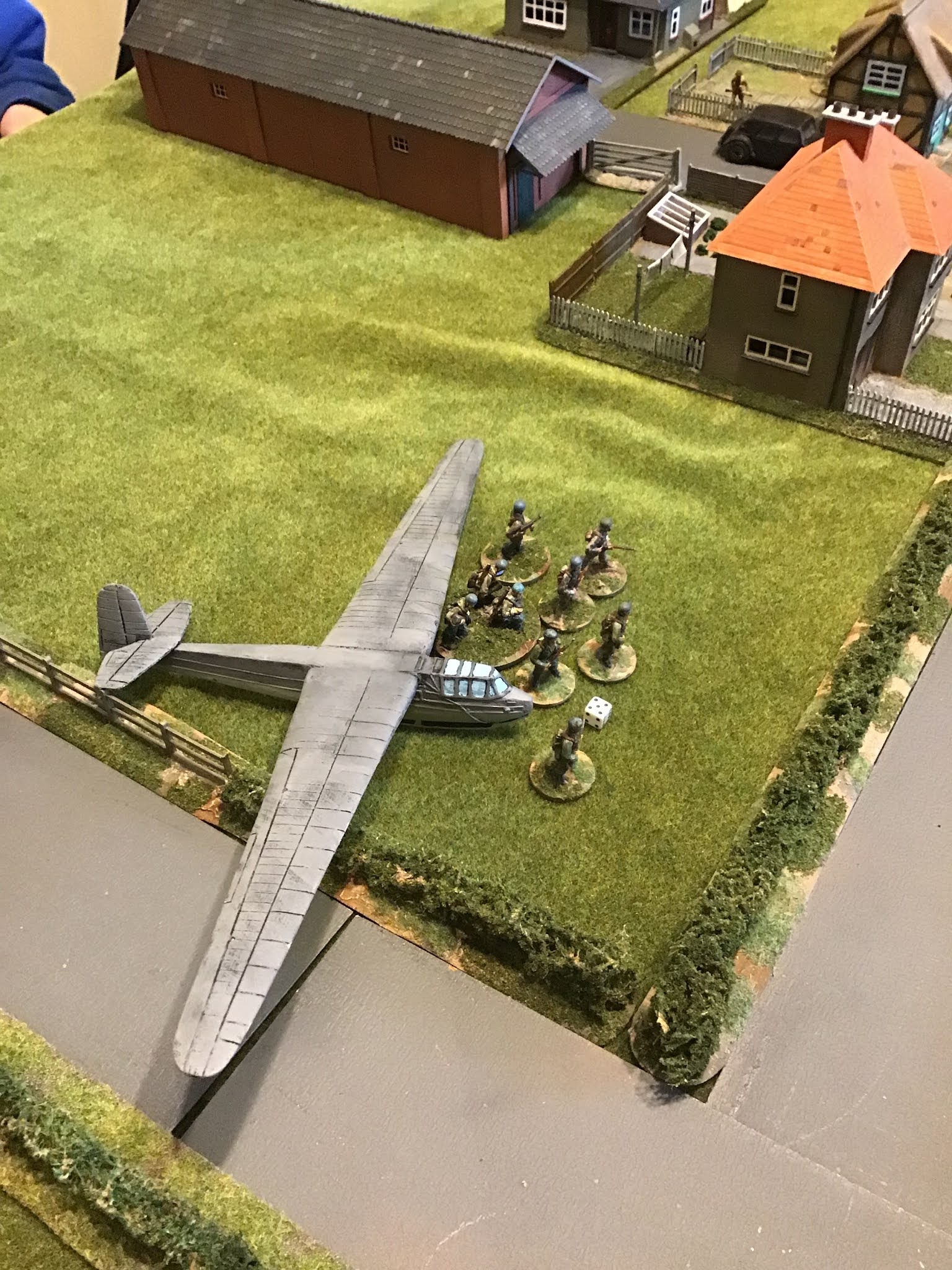
I dug out of storage and built a DFS-230 glider for the Incident at Fearnley Whittingstall game at Christmas last year. 


I also bought a De Havilland Vampire kit, which I'm counting here though to be honest it was just bought to while away the hours while my Mum was in hospital and I was stuck on my own at here house. I'll probably finish it one day.

28mm guns/vehicles

Built/painted 4, bought new 2, net progress +2

A couple of vehicles for the Woebetides and a pair of pulp-era vehicles got finished this year. I was particularly pleased with my home-made artillery limber.


28mm figures

Built/painted 213, bought new 200, net progress +13

And finally 28mm figures. Oh this is what I've been doing with my time all year!  I haven't reduced the unpainted figure pile by much but 213 figures completed is no small matter. 

Plastic figures and the smaller forces required for large-skirmish games like Sharp Practice and Lion Rampant have played a huge role in making 28mm an affordable scale for me in recent years. The smaller number of figures needed and a willingness to accept "wargaming standard" painting have also helped make getting a force "finished" in a reasonable time a realistic prospect.


In terms of productivity, I had rather slowed down in the last month or so but in the last few days I've suddenly had a craving to paint late WW2 Germans in 20mm scale. Look out for pictures soon.


Monday, September 14, 2020

Yet more Woebetides scenery

Over the weekend I built a barracoon (slave pen) for one of the groups of Arab trader/pirates in the Woebetides.


The walls are made from lengths of wicker rescued from a small basket that was going to be thrown out. Lashings of hot glue gun glue were used to keep it together and provide strength.  The roof is sculpted from Milliput laid down in "worms", squashed and sculpted with a knife.

I also made a small marker to indicate the presence of a stash of Woebetideus weapons taken from captured tribesmen.


Finally, "Grab a weapon and run!"  


I used some spare bits to create a mixed group of escaping captives. One of the younger players may start off running this group at Crisis Point.